Holosun 407k vs. 507k
By Ben Baker
Are you looking for the best red dot? We take a detailed look at the Holosun 407k and the 507k. We tell you which is better under what conditions and the gun you use.
Red dots work on all kinds of weapons. They are meant for short-range work. The unlimited eye relief makes them ideal for handguns and some shotgun applications, like bird hunting. Holosun makes excellent red dot optics. The 407k and the 507k are both top-end devices. The biggest difference is how precise you want to be with the red dot.
Differences Between Holoson 407K and 507K
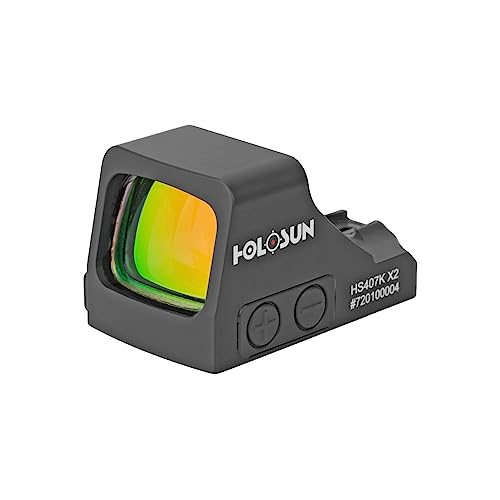
Let’s eye the differences first since this tells you which optic you want.
1. Dot Size
The biggest difference between the 407k and the 507k is the dot size. This is the first criterion to decide which is best for you.
The 407k has a 6 MOA dot. At 100 yards, the dot covers about 6 inches, and 3 inches at 50 yards. You pick red or green. The 507k has a 2 MOA dot surrounded by a 32 MOA circle. The dot covers about 2 inches at 100 yards or an inch at 50 yards. Again, choose red or green.The circle encapsulates an area of 32 inches across at 100 yards.
Why Size Matters
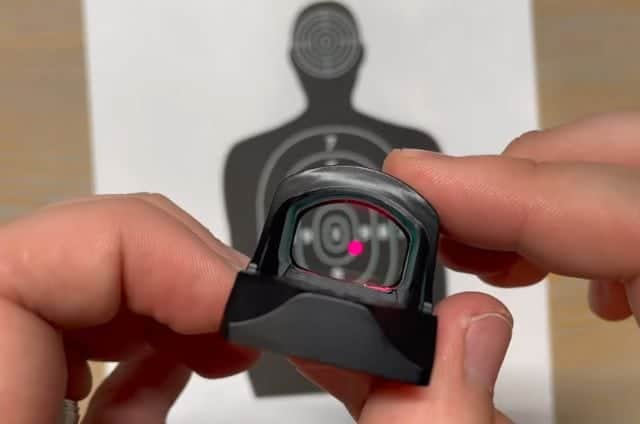
Dot size matters because of how much of the target it covers. For self-defense purposes, under 25 yards, the dot size does not really matter, at least where hiding the target is concerned. At 25 yards, both dots let you see plenty of the target. At 50 yards, you start to see an appreciable difference. The difference is palpable when moving out to 100 yards.
A 6-inch dot at 100 yards means this scope is not suited as a hunting optic if you have to shoot 100 yards or more. Seeing that big dot is easy. If the gun already has a two-inch group at 100 yards, then you are looking at an eight-inch or even larger potential group. On big animals like deer or bear, that can be OK. That is too much leeway for varmints like a fox and notes for an ethical shot.
The 2-inch dot at 100 yards is acceptable. A spread of 4-6 inches is still well within the vitals for critters like coyotes. Finding that small dot is harder to do compared to the 6-MOA monster.
Shots
If you are shooting in tournaments where speed is the key thing and targets are close, the 6 MOA is preferred by pros and regular competitors. It is just faster getting on target.
If you need precision, such as accuracy competition, you need a smaller dot to better center and deliver your shots.
WINNER: This is a draw. It boils down to how fast you need to get on target. If speed is the main criterion, get the 6 MOA. If precision is more important, get the 2 MOA.
2. Ring
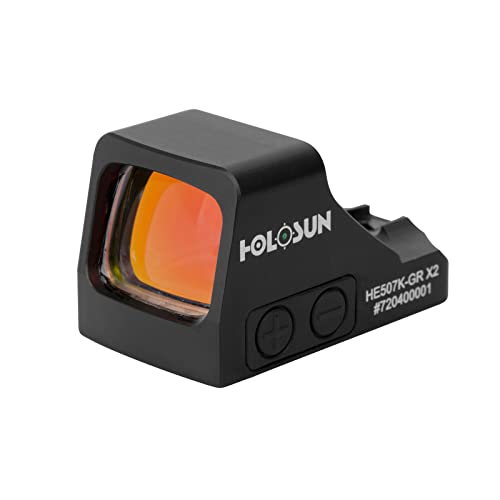
The 507 has a 32 MOA ring that also appears on the scope when you turn it on. This is a sighting aid. It helps you find the scope and then center on the target. The ring of light gives your eye something to use as a reference point when bringing the gun on target. Sometimes, you cannot see the dot until you get close to being on target. The ring has a wider view angle so you can see it sooner.
The ring also gives you a reference frame. At 100 yards, 32 MOA is about 32 inches. At 50 yards, that is 16 inches. At 25 yards, it is 8 inches. If you use the center dot and go to the edge of the ring, these measurements are halved.
With some practice, you can use the ring to estimate the size of your target. Do you need to know the target size? In some hunting situations, like a bear, yes. Some places require bears to be a certain size before you can take one. When you get good, you can use that dot and ring to estimate the spread of a deer’s rack.
The 407k has the 6 MOA dot. You can get an idea of size with the dot as a reference. It is just harder.
WINNER: The 507k has a ring and the 407k does not. No question the 507k wins.
3. Temperatures
These two devices will work in cold and hot weather. The 407k has a wide range of temperature tolerance. Storage means leaving in those temperatures will not harm it. The scope may not work at the far temperature extremes. You will have to warm it up or cool it down a bit to see the dot. -40 degrees is the same in Celcius and Fahrenheit. This is the only time the two temps are identical.
407k
- Storage Temperature -40℃ to 70℃ or -40 F to 158 F
- Working Temperature -30℃ to 60℃ or -22 F to 140 F
507k
- Storage Temperature -20℃ to 65℃ or -4 F to 149 F
- Working Temperature -20℃~51℃ or -4 F to 124 F
The upper end only matters with storage unless you happen to be caught in a fire or work in a foundry. Inside-vehicle temperatures can hit those upper limits on a hot summer day in the South. On the cold side, catching outside in -40 below weather is certainly possible. Hunting at -4 F or -20 C happens, especially in the north.
WINNER: The 407K scores the victory. It has a broader range of temperature tolerance and function.
Ben Baker is the Executive Editor of B&H Publications, including the Wiregrass Farmer Newspaper in Ashburn. He also is a member of the Georgia Outdoor Writers Association. Ben can be contacted at redneckgenius@gmail.com.