You need to be aware of both!
Spring 2026
By Steve Hudson
Tybee Island, east of Savannah out U.S. 80 and tucked up close to the South Carolina line, is a place from my childhood. In years past we would visit Tybee on trips to the Georgia coast, banking memories of ocean and sea breeze and water-water-all-around.
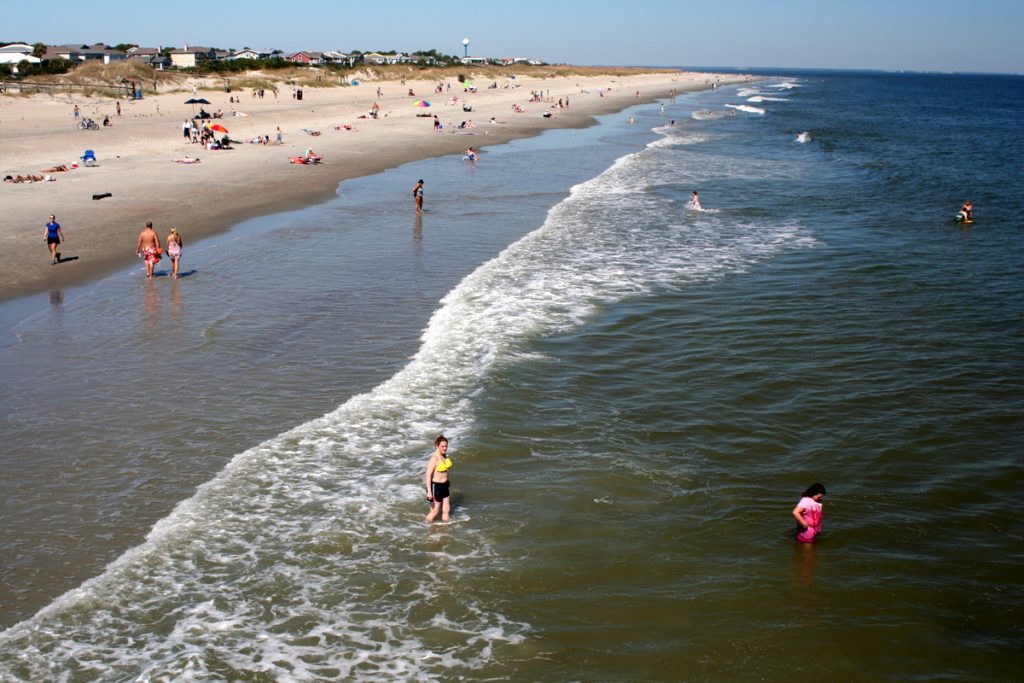
Tybee Island beach. Photo by Jimmy Jacobs.
Yes, I’d been there many times as a child, though never for fishing.
Now that was about to change. The word was that redfish were in, and I was on my way to find them.
Though I live far from the nearest ocean, I’ve done my share of saltwater fishing. Most has been in Florida where the fish are diverse and the tides are usually mild and cooperative. But the ocean is a big ol’ place, and saltwater has many faces – as I was about to find out.
Accompanying me on this Tybee Island revisitation was my favorite saltwater flyrod – a 9-foot, 8-weight rod. It’s served me well in saltwater settings for many years, and I figured it would be up to any redfish I might find.
The miles ticked by, and pretty soon I was on the home stretch.
A guy at a fishing shop near Savannah had given me directions, and the hastily scrawled map soon told me that the parking spot was getting close – and all of a sudden there it was. I pulled off the road, climbed out of the car and stretched. Ahead of me stretched a broad sand flat, marked here and there by random depressions and partially buried logs.
And I knew that out there beyond the sand, out there in the hazy distance, there was water – and maybe redfish too.
Something told me this was going to be a memorable day. This, I thought to myself, is going to be fun.
As I rigged my fly rod, another vehicle pulled into the parking area too. Two folks hopped out and began unloading the two kayaks strapped to the top of their car. Then they, too, began rigging flyrods – a good sign.
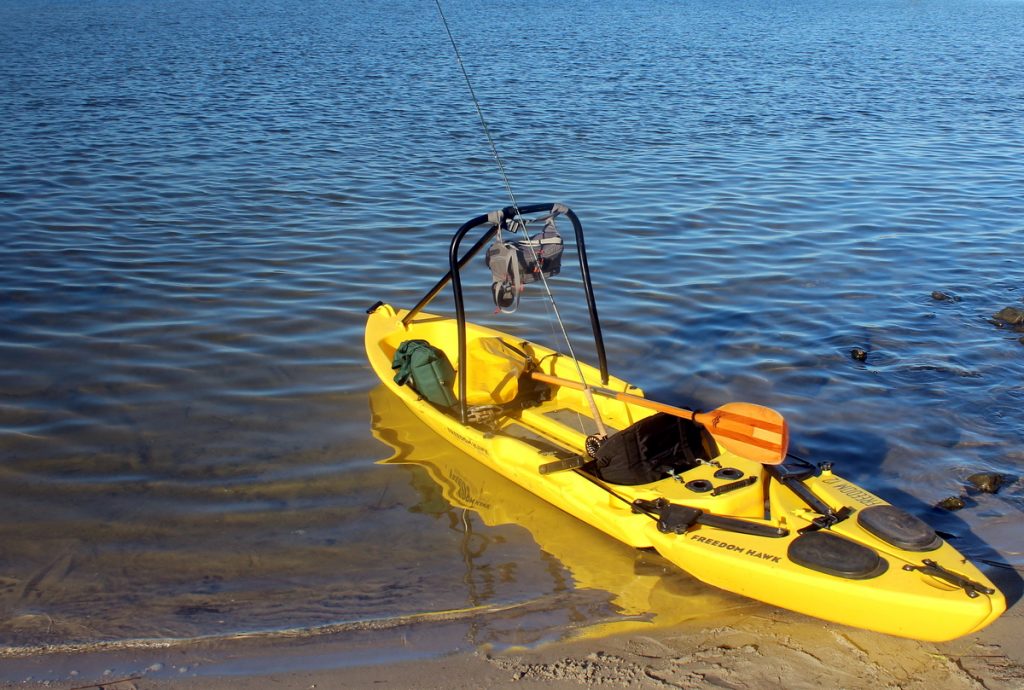
Photo by Jimmy Jacobs.
“Flyfishing?” I asked.
“Yep,” the nearest of them replied. “Reds have been out here the last couple of days. Some nice ones too. Gong to see if we can get lucky again.”
Again, eh? Well, well!
“You fishing?” asked the second fellow.
“Going to try,” I said. “But I wish I had a boat like you guys. It’s wading for me today”
“Wading?” said the first angler with a faint shake of his head. He added, “That can be tough with the tide.”
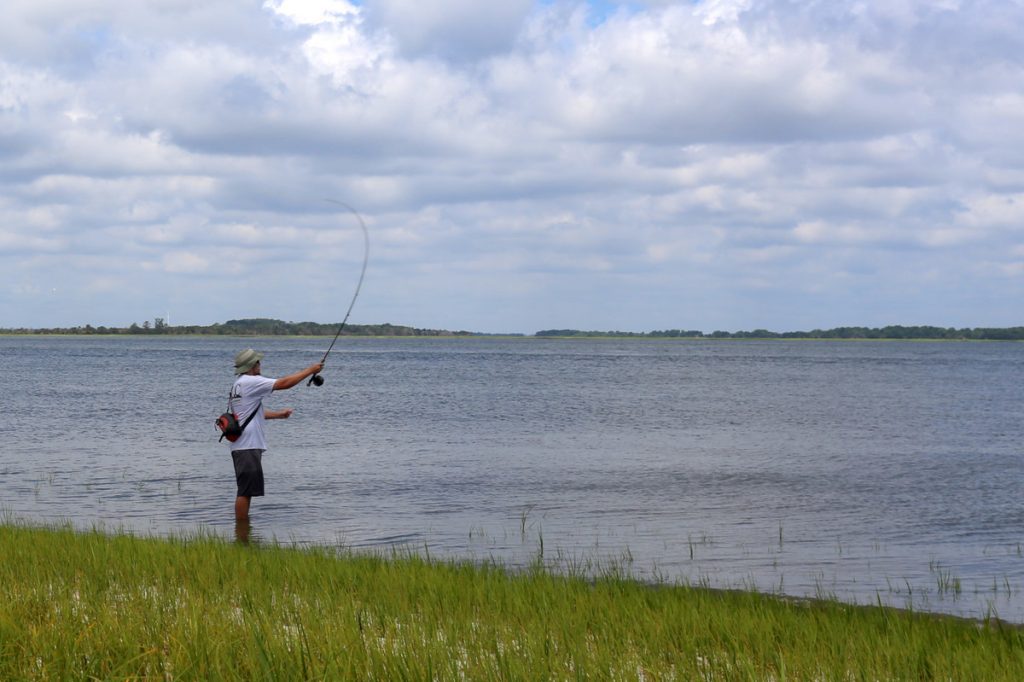
Wading can be a dicey proposition on Tybee Island. Photo by Liz Thorton.
Tide? I gazed out over the sand. I’d dealt with tides in Florida, and I’d never had a problem. Yeah, it seemed like I’d heard something somewhere about Tybee tides. But at that moment the water seemed a sedate, peaceful, and long way off.
I glanced toward the ocean once more, just to be sure. Yeah, I should be okay.
Changing the subject, I asked, “Any thoughts on flies?”
“What you got?” the first guy asked, and I showed him my box of Clousers and Gurglers. I had several of each in sizes 1 and 1/0.
“Those should do,” he said, “if you can get to the reds before the tide gets too high.”
That’s twice they’d mentioned tides. I should have heard what they were saying. At the very least I should have inquired further. But you know how it is. Sometimes we like to think we’re all experts at everything. Instead, I just said, “Thanks.”
The kayakers looked at each other and kind of shrugged. Then they set out across the sand, toting their boats toward the water that waited out there somewhere in the afternoon haze.
I decided I’d better get going too. I started across the sand, too, picking my way around deeper holes and foot-grabbing snags as I angled toward a spot that somehow looked good. Beyond it, the water now seemed a little closer. But maybe that was just an illusion.
That’s when I saw it: the unmistakable splash of a feeding fish.
Squinting, I spotted more movement. Was it redfish? I had a feeling – a good feeling. If I could just put a fly in front of the!
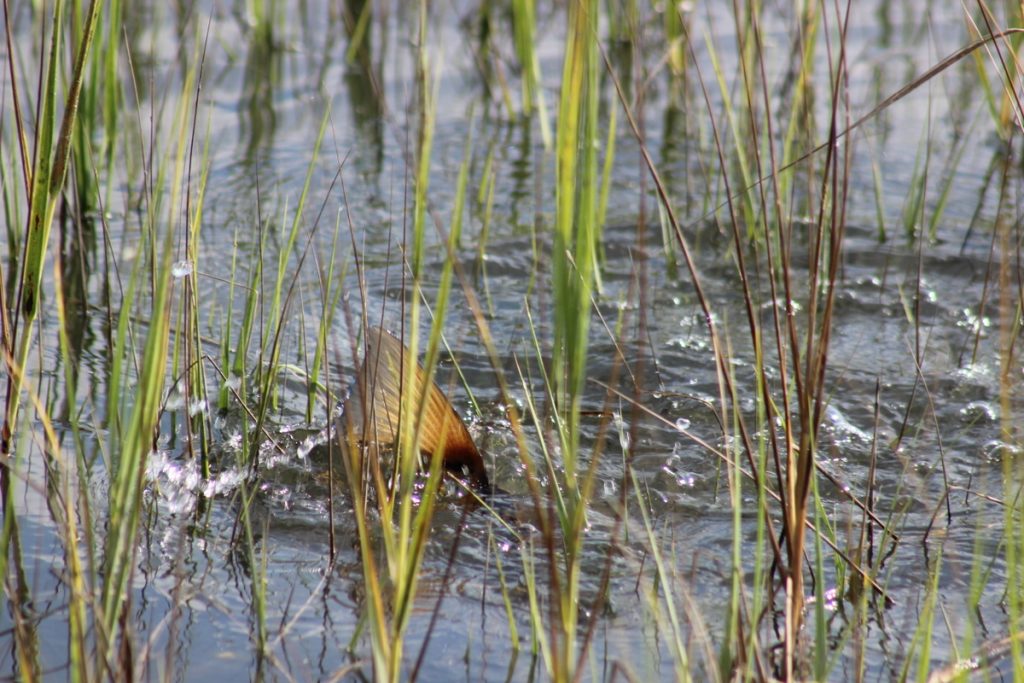
Was it a redfish? Photo by Jimmy Jacobs.
Again, I looked at the water, which seemed to be moving in a little faster than before. In fact, it now flowed over the sand in front of me, an inch or two of ocean that lapped at the toes of my boots. For a fleeting instant I remember thinking that maybe I should have checked those tide tables after all.
But then another flash of feeding fish grabbed my attention. I blinked to clear my eyes for a better look, and I saw that the action was surely getting closer — now no more than 60 or 70 yards out — and definitely moving my way.
I know, I know. I can hear what you’re going to say. But you know how it is when there’s a good fish right there, a fish that’ll be within range in a matter of minutes? Surely you do, and surely you can understand why I stood there, mesmerized, watching the fish approach, calculating the cast –
Meanwhile, the fish had moved another 20 yards closer. At that rate they’d be within range in a matter of seconds.
“Don’t worry, fish,” I said out loud. “Come a little closer. I’m going to turn you loose you know. But I sure do want to feel you pull before I do.”
I stood there, attention focused on fish that continued to move closer as if I wasn’t there. All I had to do was wait. I had time. Didn’t I?
Based on past experience, I had all the time in the world. Still, and just to be sure, I turned my gaze back toward shore to double-check the route back to the car.
Uh-oh.
While I’d been mesmerized by those fish, the tide had been getting busy. In fact, it had covered pretty much the entirety of the once-dry flat I’d crossed to the get there. Where there had been that endless expanse of sand not 30 minutes before, there was now an equally endless expanse of water. Dry land, swallowed up and now completely hidden by the impenetrable mirror surface of the incoming tide, had disappeared beneath a featureless watery tableau.
Uh-oh. Time to go. Time to find the route back. But where was it? Where was the route I’d followed in?
I knew exactly where it was. It was somewhere under all that water.
And still the tide came in, relentless, determined.
Forgetting the fish, I began the nerve-wracking task of finding my way back to the car. Despite the afternoon sun, it felt like I was walking in the dark, picking my way across an unseen, unknown landscape. I moved slowly and tentatively, testing each footfall carefully lest I step into a hole or trip over one of those partially buried logs.
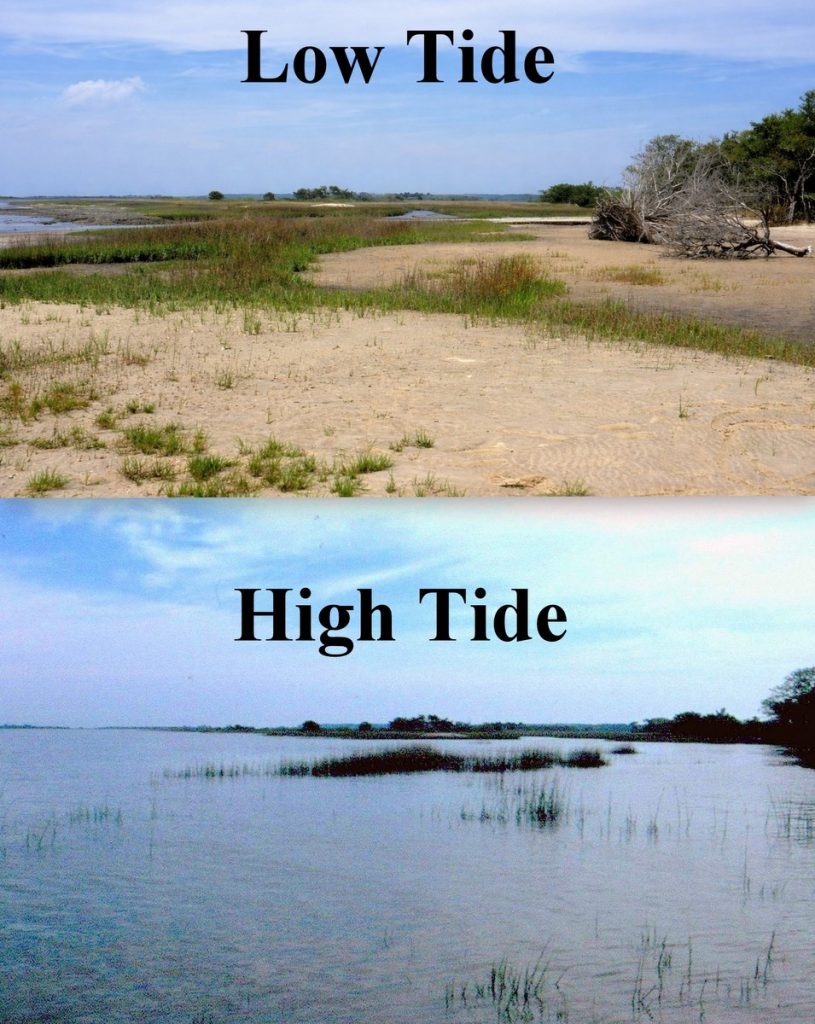
Georgia’s 6- to 9-foot tides can move the water very fast. Photos by Jimmy Jacobs.
It was slow going, thought the tide wasn’t slowing at all. And I admit it: For this guy from the foothills, it was just a little scary.
You’re reading this, so you know I made it back to the car. Once there, I breathed easier. I broke down the rod and stowed it behind the seat. I took off the boots and toweled my feet dry. Fresh socks and landlubber shoes completed my transformation to a creature of the dry land, and at last I was back where I belonged.
But instead of leaving right away, I sat there in the car and looked out over all that water where only a little while ago there had only been sand. The tide, by now, was really coming in, and the water on the flat was getting deeper by the minute. I realized that I really didn’t know a thing about handling such tides.
Yessir, I’d dodged a bullet. But did I catch a fish for my trouble? No. Not a single one.
About that time, I spotted the two kayak anglers paddling back in. I heard them laughing happily about something, the sound floating to me over the incoming water as sound over water is prone to do.
I saw one of them spread hands apart as if to show the size of a fish.
I sighed. They’d been right to wish me luck – and to consider a kayak.
And just like that, my mind jumped to future tense. Mental gears began to turn.
A kayak? Why not? It would fit on top of the car. And it would carry me on grand adventures across the interface between my world and that of the fishes, whether here in this wide expanse of saltwater, there on some dancing river, or even there through the glass-smooth twilight on a quiet Georgia pond.
Sure, wading is good. But there are options. Options can be good too.
I started the car and pointed it homeward and thought to myself again: This is going to be fun.
Steve Hudson is a freelance outdoor writer, book author and award-winning member of the Georgia Outdoor Writers Association. Steve makes his home in Canton. You can contact him at aa4bw@comcast.net.