A Crappie Fishing legend
Spring 2026
Article and photos by John Trussell
Best known as the inventor of the Hal-Fly crappie jig, Hal Barber was the first to manufacture “jelly bellied” jigs, which he called the Dina-Mite jig. He also was instrumental in popularizing the multi-rod trolling method of crappie fishing. Most of today’s crappie anglers, and especially tournament participants, use the trolling methods Barber began developing back in 1968.
Like many serious anglers, Barber cut his teeth chasing largemouth bass. Early on, while living in Miami, Florida., he waded giant Lake Okeechobee alone, casting for bass. Then after moving to the Peach State, he began fishing Lake Lanier in 1958.
It was in that same year that he first turned his attention to papermouths. During a trip to Lanier in 1958, he spent a day casting a white Doll Fly with a red collar into a crappie school and found the sport addictive. That, however, was not his first fishing trip for slabs. He recalls his initial crappie venture as having been with his dad, when he was about 6 years old. His dad made a dip net from some old screen wire that had been on their back door. The net was sprinkled with cornbread and then lowered into the water to catch the minnows, which were then used to catch the crappie.
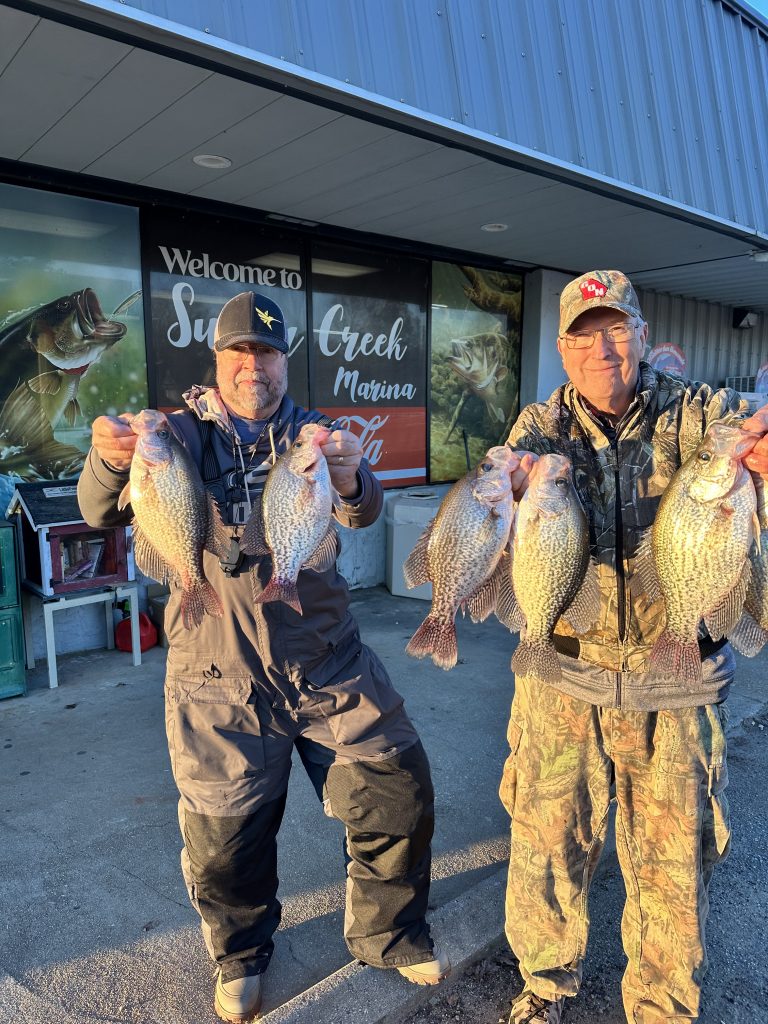
The author on the right with Joe Partenza holding some Lake Oconee slabs. Photo courtesy of John Trussell.
Barber said that when he got serious about crappie fishing in the late 1960s, he fished with jigs and let his boat drift with the wind. As long as he had a breeze blowing, he always seemed to catch fish. This led to experimentation with using a trolling motor when there was no wind. However, he mounted the motor on the side of the boat to simulate the natural drift with the breeze that always worked for him. Unfortunately, this made the boat uncontrollable and he moved the motor to the transom.
His first successful day using the trolling tactics was in November of 1970. Using four rods, he caught 54 crappie in three hours on Chewala Creek in Walter F. George. After that day, he knew he had the method perfected.
With his boat now under control, Barber spent a lot of time fishing and changing lures in search of the best color scheme. That meant changing his jig often, which was a pain when tying a conventional loop knot each time. He soon came up with the single overhand loop knot, which could be quickly tied and saved a lot of time. Later this technique became known as the Hal-Fly knot.
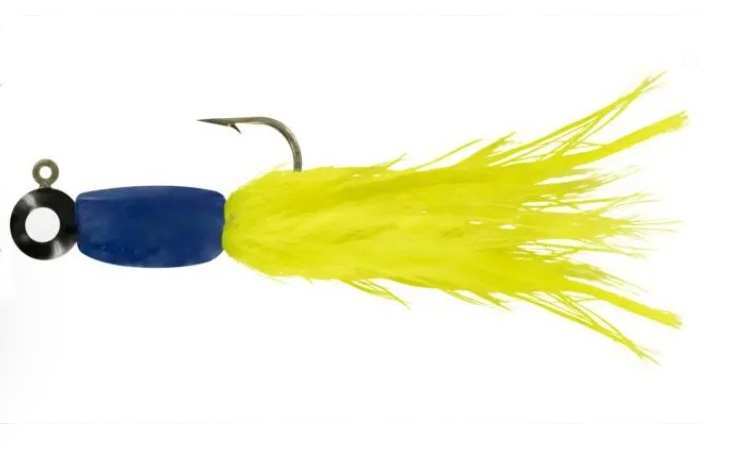
The Hal Fly. Photo courtesy of Big Bite Baits.
Barber’s next endeavor was to improve on the jigs he fished with. His first experiments were done on a conventional fly-tying vise, but that proved quite slow. Since he almost immediately began selling the lures to friends at eight cents each, he needed a better way to produce them. After two years of effort, he came up with a machine that was capable of tying 200 jig bodies per hour.
Still not satisfied, his next jig was quite different from anything then available. He had been kicking the idea for the jelly-bodied jig around in his head. He figured that with a jelly-bodied jig, unlimited color varieties and weights could be manufactured easily, without the hassle of dealing with chenille.
By 1972, he produced the master mold for the Dina-Mite jig. He took samples of the new lure over to Goat Island at Santee Cooper Lake in South Carolina, where they proved quite successful on the papermouths. Next he introduced the Dina-Mite jig on Lake Walter George that same year and then carried it to Walker Harris Marina (now simply Walker Marina) on Jackson Lake. The marina put on the first crappie tournament in 1972 and Barber signed on as a sponsor. Everywhere the new jigs were fished, they were an instant hit, with both the anglers and the crappie.
Through the 1970s, Hal Barber spent as much time as possible out field-testing his new jigs. Some of those trips produced astounding results. One January on Jackson Lake he boated 140 slabs in five hours. On a three-hour trip to Walter George, he and his party of anglers used the Hal-Flies to bring in 62 crappie that weighed a combined 105 pounds! Two of the most impressive days on the water took place on West Point Lake. On the first he caught and released 101 fish in only 75 minutes, and at the end of the day the count had risen to 177. The following spring he bested that mark by putting 201 papermouths in the boat while on the reservoir’s White Water Creek arm.
All through this period, Barber kept constant records of weather conditions, depths and water temperatures at the places he caught fish. He found that wind, sunlight, temperature and wave action all could influence the color of jig the crappie wanted. For instance, one day he fished with an 18-mile per hour wind blowing as a cold front approached. The slabs readily hit a red (head), green (body), and yellow (tail feather) jig that day. He went back the next day to the same area, and the fish would not touch that jig. Rather, he soon discovered that the jig they wanted this day was yellow teamed with yellow and white.
Obviously, this led to his producing a variety of color combinations. White, blue and white is a pattern that he has found catches fish on most lakes. But in the winter, red, green and yellow is hard to beat, especially if the water is slightly discolored.
With regard to the revolution he started in crappie fishing, Barber had mixed feelings. Both crappie fishing tournaments and the use of spider rigs of eight or more rods in a single boat are not on his list of favorite activities. At their extreme, Barber feels these activities can even be detrimental to the fisheries on our lakes, but understood that anglers want to try new fishing techniques.
What started as a small fishing project in his backyard workshop grew into quite a career for Hal Barber. It also proved to be a boon to all anglers who pursue crappie in Georgia. Barber eventually found the working regiment difficult as he got older and working two jobs, one as an air traffic controller, and decided to sell his business and the trade name.
A group from Warner Robins, consisting of Billy Wilson, Chuck Lawson and Bill Franklin ran out of the so- called Christmas Tree jig (red head, yellow body, green tail) that they were catching crappie on at Lake Oconee. They called Barber to get more jigs and he informed them the company was for sell. Billy Wilson and Bill Franklin were serious crappie anglers and tournament competitors. Chuck Lawson owned Chucks Bait and Tackle (now Chuck’s Bait, Tackle, Gun & Pawn) in Warner Robins. Soon they took a trip to Morrow, Georgia to meet with Hal Barber.
Barber told the group he wouldn’t show them his trade secrets unless they gave him $10,000. Once they had invested that large sum of money and liked what they saw, they negotiated the final price for the company, but that amount is unknown.
Eventually Billy Wilson bought out the other investors. Billy Wilson passed away, as did my good friends Chuck Lawson and Billy Franklin and the company was eventually acquired by Big Bite Baits. So, Hal Flys are still out there, which is a great thing and would make Hal Barber proud! Hal Barber passed away in 2018, but his legacy of the Hal Fly jig lives on!
John Trussell is a freelance writer making his home in Warner Robins. He is a member of the Georgia Outdoor Writers Association and a 2014 inductee into the Georgia Hunting and Fishing Hall of Fame. John can be contacted at jtrusswr@gmail.com.