Flatfish on the Georgia Coast
Fall 2026
By Ron Brooks
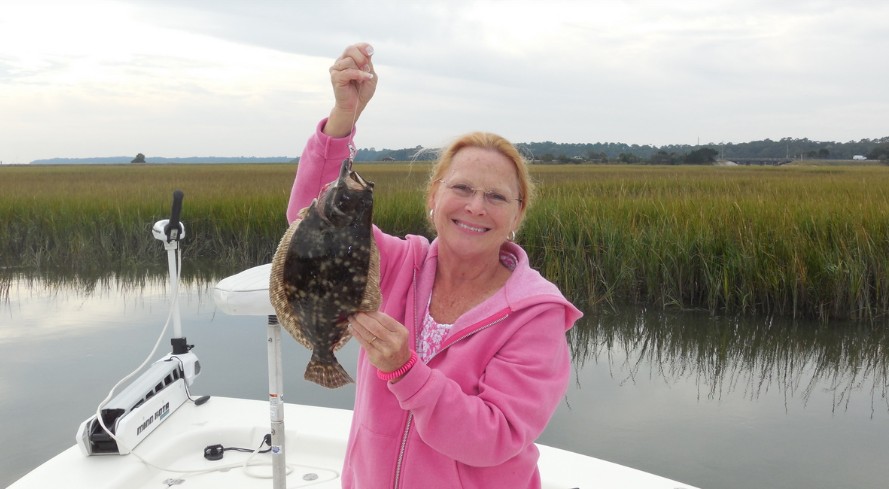
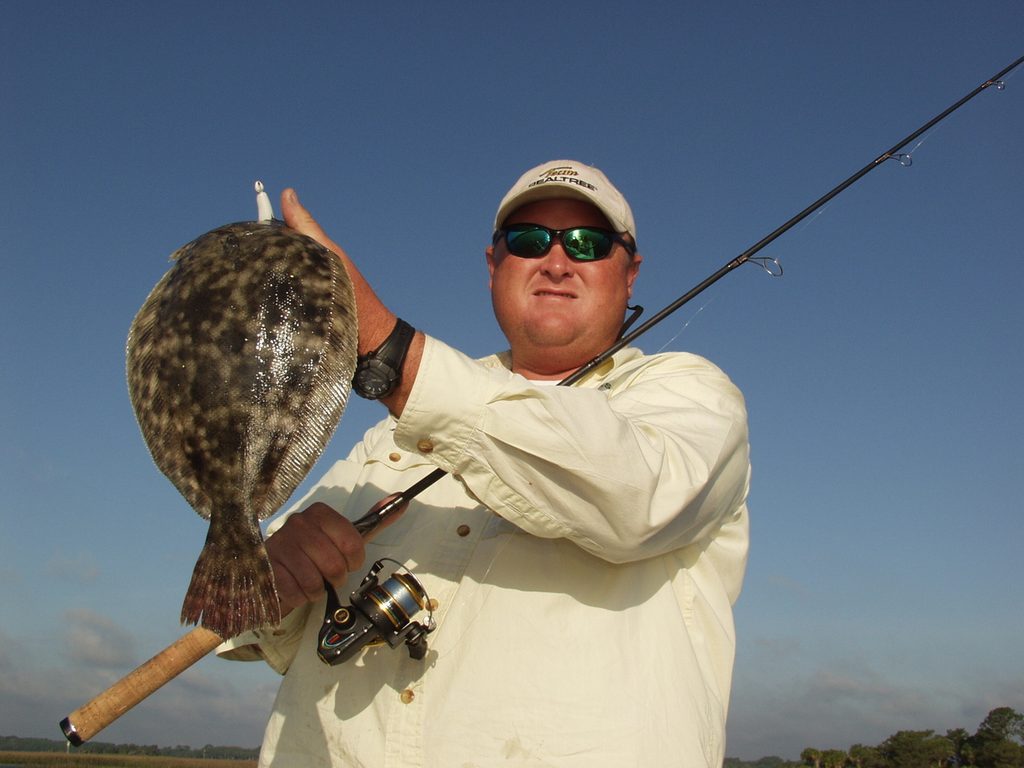
August was extremely hot, and September promises to be almost as bad. Lots of fishermen tend to stay at home during these late “dog days.” If they do, they will miss out on some fine flounder action in the creeks and rivers on the Georgia Coast. The baitfish are invading the estuaries and are in virtually every creek. The foraging fish are right there with them. Flounder, specifically, are easy to catch this time of year if you have the right bait and the right tactics.
As the Fall season progresses, flounders will be migrating out of the creeks and sounds to deeper water on the nearshore reefs for the winter. This is the time to find some doormats leaving the shallow water.
Anglers who target docks, creek mouths, and runouts on an outgoing tide will do quite well filling out a limit of fish. Flounders position themselves at the mouth of these creeks and runoffs or behind pilings while waiting for a meal to come off the grass and mud flats and into their striking range.
Casting jigs with either screw tails, grubs, or live bait up into the creek and working them out and over the waiting flounder is the ticket. Many times, it takes several casts to garner a strike because the flounder won’t move very far to attack a bait. Consequently, make numerous casts and work your baits over the entire bottom area.
Flounder, like a lot of other fish, really don’t like swimming in heavy currents. They prefer to sink right into the bottom sand or mud, out of the current, lying in wait for an easy meal. They will camouflage themselves in the sand or mud right at the entrance to a creek where they will be facing the mouth of the creek on an outgoing tide. They’re looking for a meal of baitfish coming off the mud and grass flats.
Docks, pilings, and piers provide ambush points for flounder. Next time you go by a piling in the water, take notice of the current as the water moves past the piling. An eddy forms on the back side of the piling, and the larger the piling, the larger the eddy.
Flounders often position themselves on the down current side of a piling and lie on the bottom in wait. Baitfish, shrimp, small crabs, and other crustaceans that are being carried by the current tend to swirl and linger in an eddy just long enough for a flounder to have a good meal.
Although fish can be caught on this pattern on either an incoming or an outgoing tide, you should plan to fish an outgoing tide. Natural bait coming off mud flats and oyster bars will move out with the tide, providing more food for the fish. Flounder seem to know this, and the bite is usually better on that outgoing tide.
Use a jig with a screw tail or swim-tail plastic. A 4-inch Bass Assassin Saltwater Sea Shad in an Electric Chicken or white/pink color works well. These two color combinations work well not only on flounder, but on speckled trout and redfish as well. They are a favorite plastic bait and color scheme for many fish.
For natural bait, a small finger mullet surpasses almost all other baits. A school of finger mullet running the edge of an island or grass line can be caught with a small cast net. Ideally, they should be about 4 inches long. If they are too large, the flounder may let them swim. Smaller is better than larger in this case. If the mullet won’t cooperate, opt for mud minnows; or if they are in short supply, use live shrimp.
In all circumstances, use a plain jig head. The size of the jig to use depends on the current and depth of the water being fished. Shallower water means lighter jigs; deeper water means heavier jigs. Use a quarter-ounce jig on the small end of the scale, up to a three-quarter-ounce jig on the heavy end. Use as light a jig as possible – only what is required to get your bait down to the bottom.
Ron Brooks was a long-time resident of metro Atlanta and now living in Jacksonville, Florida. He is a member of the Georgia Outdoor Writers Association. Contact him at jbrooks@bellsouth.net.