Is there hope for quail in the Peach State?
Spring 2026
By John Trussell
The prince of game birds, the bobwhite quail has all but disappeared from our fields and woodlands, but there are several efforts to bring them back. Many of you might remember that prior to the 1970s bobwhites were plentiful. If you went hunting with a good quail dog, you could count on finding two to three good coveys of birds, often more, on a half-day hunt.
But over time all the quail have greatly diminished from the landscape. I still run across a random covey, but I don’t hunt wild quail anymore, as I think they need all the help they can get to replenish their numbers.
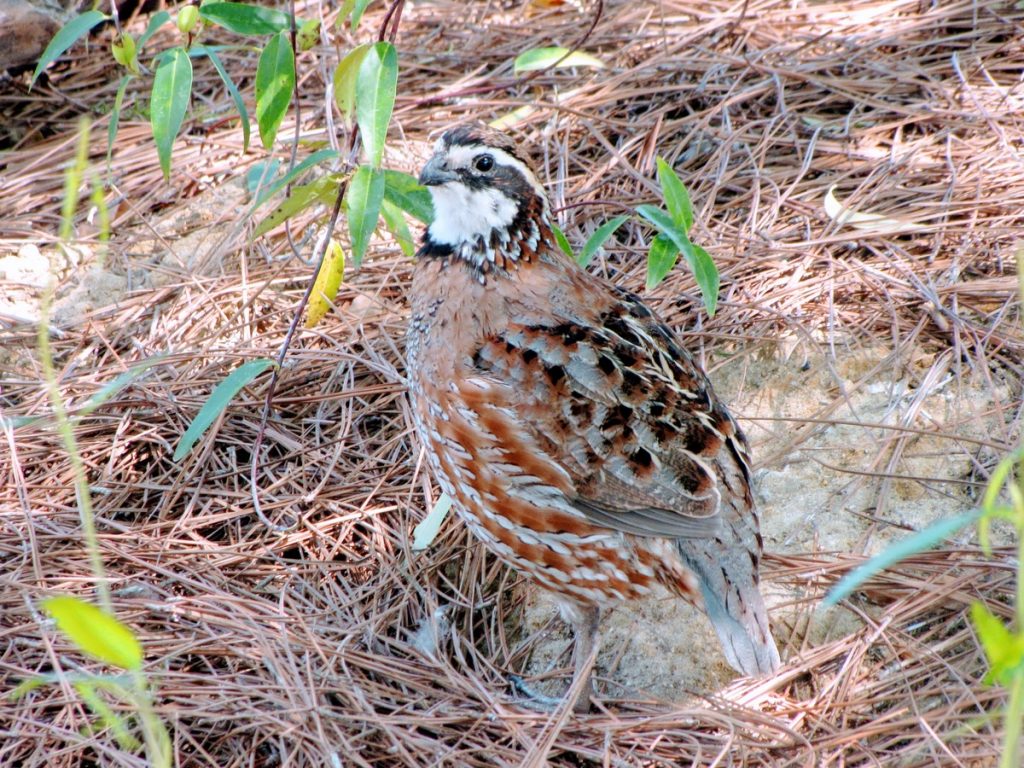
Photo by John Trussell.
No one seems to know what happened to the quail but it’s probably a complex situation. Wildlife biologists that I have spoken to about this issue say it’s not just one problem, but a host of environmental and land change problems that may be impacting quail numbers.
There are five major culprits that most wildlife biologists point to as reasons for the dramatic drop in quail populations: Loss of quail habitat, intensified farming and forestry practices, succession of grassland ecosystems to forests, overwhelming presence of exotic grasses like fescue that choke out wildlife and urban sprawl. If you add in fire ants, and changes in agricultural chemical use, those reasons for the near genocide of the popular game species.
Fortunately, farmers are the ultimate ecologists and environmentalists and millions of acres of farmland in the Southeast are being farmed today in a much more ecology friendly way than was the typical fence post to fence post style of the 1970s.
For sure, the biggest loss of farmland in the past 25 years has come from conversion to urban use. Still, there are millions of acres of farmland — much of it long distances from any urban influence, and the quail are gone from these farms, too.
Are the use of herbicides and pesticides the reason for quail’s decline? These chemicals make the good life we are used to possible, as they eliminate pests that eat the crops and weeds that crowd out the food crops. But there is a balancing point that has consequences on the environment. The herbicide Round Up and many other chemicals are used routinely on many crops and ends up in our food supplies. Chemicals kill harmful bugs, but also harm bees that pollinate the crops, thus causing Honeybee colony decline, a serious problem. Without bees there would be little crops!
Fire ants have increased dramatically in the last 50 years, particularly the varieties from overseas that have invaded Georgia. I have seen areas where the ground was literally crawling with fire ants and a newly hatched quail chick doesn’t have a chance of survival. Throw in predation from coyotes, raccoons, wild hogs, hawks, and other hungry animals, and you can see that it’s tough on quail to survive. But it’s not just quail that are in trouble.
The Audubon Society is reporting that the general bird population is down about 30 percent in the nation from the 1970s. Unfortunately, I must agree with that poor assessment. When I was much younger, I used to see eastern meadow larks by the hundreds, now I see some single birds occasionally. Red winged black birds used to fly across Middle Georgia in large migratory flocks that numbered in the hundreds of thousands. Now the flocks are much smaller with fewer birds.
Night hawks, also called bull bats, used to fly across our fields by the hundreds, chasing bugs. But today you’ll be lucky to see a single bird in the evening sky. All this is a wake-up call that is occurring in our brief lifetimes. Some may say its climate change, but a one-degree change in average world temperature is not the cause of quail decline. But what can we do to help?
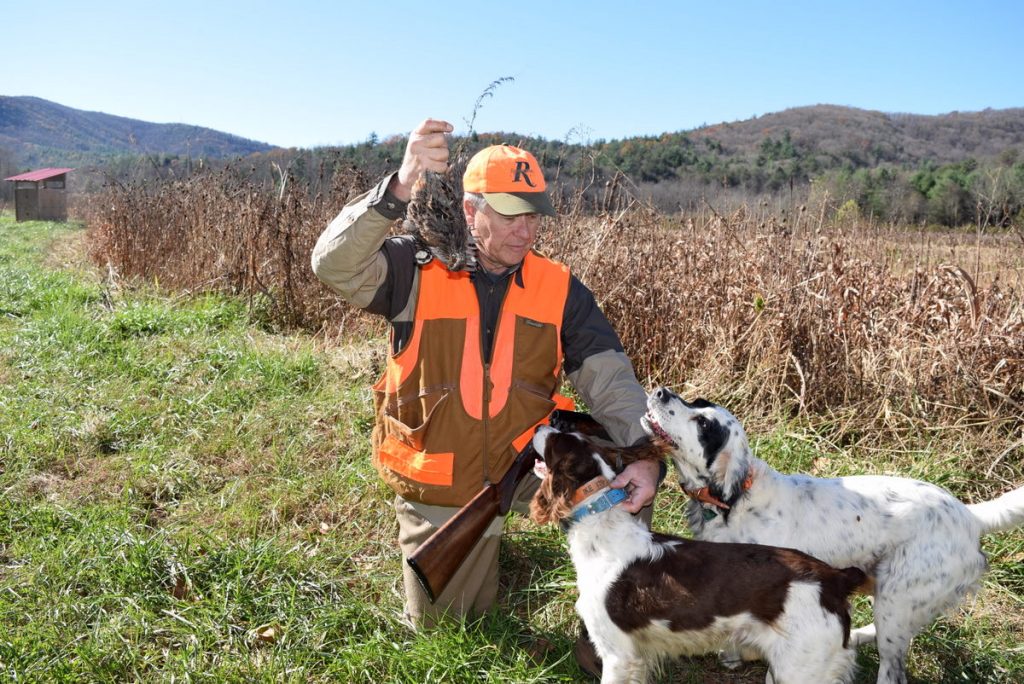
Georgia Outdoor Adventures Editor Jimmy Jacobs with Brittany Ike and English setter Jake at Noontootla Creek Farms near Blue Ridge. Photo by John Trussell.
The best chance of quail to come back is on private properties that take specific actions that benefit quail as recommended by the Georgia Department of Natural Resources. The DNR recommends habitat changes that benefit natural quail populations like open woodlands that are burned off frequently to encourage native weeds and seeds to grow. These practices have been followed for generations on the many quail plantations around the state, especially around the Thomasville area. This area is often called the “Quail Hunting Capitol of the World’ for good reason.
In the late 1800s, wealthy northern business executives began purchasing large tracts of land in the Red Hills region, concentrated primarily between Thomasville and Tallahassee. Former cotton plantations soon became private quail hunting plantations where they could get away from harsh northern winters and buy land for $3 per acre! Back then a dollar was worth something!
Some landowners built lodges or winter residences in the “Piney Woods,” and many of these hunting plantations are still owned by the families that purchased them in the late 19th century. Most quail plantations are closed to the public, but one Thomasville plantation, Pebble Hill Plantation, is no longer used for hunting. It has been repurposed as a living museum and special event venue.
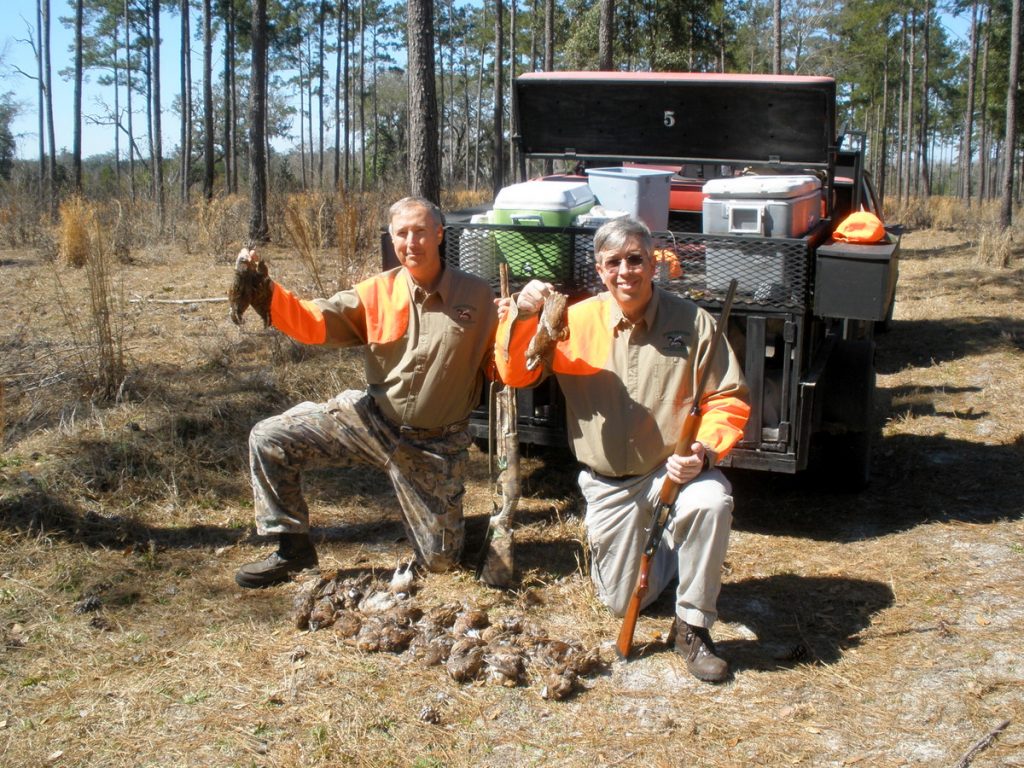
The author (left) and Steve Gochenour had a very successful quail hunt at the Dorchester Quail Plantation near Midway. Photo courtesy of John Trussell.
Pebble Hill Plantation and its 3,000 acres are rich in history and beauty. Established in the 1820s by Thomas Jefferson Johnson, then Johnson’s daughter Julia Ann Mitchell continued to own the historic Pebble Hill until the 1890s. Pebble Hill’s modern history begins with its acquisition by Howard Melville Hanna from Cleveland, Ohio in 1896. At that time Thomasville had become a resort area frequented by northern visitors. Hanna’s daughter, Kate Hanna Ireland Harvey was given Pebble Hill in 1901 by her father. She enjoyed the site as a winter home and shooting plantation and developed Pebble Hill as it is today. After Mrs. Harvey’s death in 1936, the property passed to her daughter, Elisabeth Ireland Poe, who died in 1978. Through her generosity, a private foundation was established so the public could enjoy her beloved Pebble Hill. Mrs. Poe realized that she owned the land only for a short time and that soon it would be passed on to a new generation, so she strived to be a good steward to preserve and protect our natural resources and open the plantation up to the public. Click here for more details about Pebble Hill.
I encourage you to visit the “Quail Belt” down in southern Georgia around Thomasville and drop into Kevin’s Fine Outdoor Gear & Apparel, as well as the many stores in the old downtown. For more information click here.
What’s the future for our beloved bobwhite quail? The Georgia DNR and Quail Forever are reaching out to landowners with specific guidelines to help increase quail numbers in Georgia. Click here for more details from the DNR, or here for Quail Forever.
Recently, while rabbit hunting, I jumped a big covey of quail. Also, when I was driving to Eastman a large covey flew across the road. Both happy incidents brought a smile to my face and gave me hope that quail populations might be increasing! Time will tell!
John Trussell is a freelance writer making his home in Warner Robins. He is a member of the Georgia Outdoor Writers Association and a 2014 inductee into the Georgia Hunting and Fishing Hall of Fame. John can be contacted at jtrusswr@gmail.com.