Only this one doesn’t require a long airline flight and it includes some fishing action!
Fall 2023
By Ron Brooks
Rome, Georgia! Even though it’s a city in the southern United States, it still connects with the old-world Rome in Italy. The Capitoline She-Wolf statue of Romulus and Remus fame replica was donated to the city by dictator Benito Mussolini in 1929. Rome, Georgia, was home to many Italian immigrants at the time. Today that statue sits on a pedestal in front of Rome’s City Hall.
A fascinating city to visit, Rome sits on seven hills, just like its European namesake city. The beauty of two rivers merging into one at the very center of the city also makes for some exciting and entertaining angling options. The confluence of the Etowah and Oostanaula rivers in downtown Rome form the beginning of the Coosa River. The Coosa’s water makes its way over to Alabama and eventually empties into the Gulf of Mexico at Mobile via the Alabama River.
Where the Coosa River heads west out of the city of Rome, there were some shallow rapids many years ago that caused problems for boat traffic. In 1910 to 1913, a small dam and accompanying lock were built at Mayo’s Bar to allow deeper draft vessels to traverse the river carrying goods from Rome to Mobile.
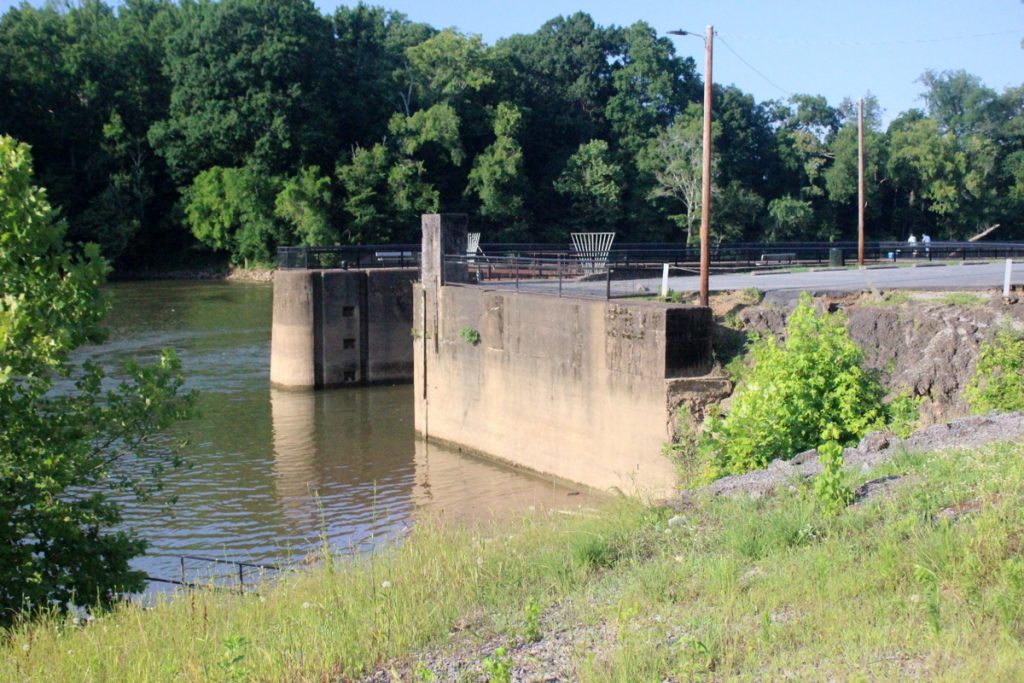
The Mayo’s Bar Lock and Dam on the Coosa River. Photo by Jimmy Jacobs.
Standing on the edge of the lock, remnants of the old dam are visible just under the water. There is a boat ramp at the foot of the lock, and adjacent to the lock is the Coosa River Trading Post, where fishing and camping supplies are found. Of interest to all anglers, a stop at the Bragging Board in the trading post provides pictorial evidence of the fish to be caught in the river.
Catfish are the day’s order for many Coosa River anglers. Blue, channel, and flathead catfish are all plentiful and quite willing to cooperate from the looks of those pictures! The fishing method is simple. A standard bottom rig with a hook, sinker, and some nice wigglers will put a catfish on your line.
Most catfishing anglers allow the river current to move them down the river slowly. Their baits are dropped into the water and allowed to bounce along the bottom. It doesn’t take long to hook up. This method produces mostly channel catfish. Larger cats are caught on larger baits, often live minnows, shiners, or bream. And, 10- to 20-pound and even larger catfish are not uncommon catches bouncing the bottom.
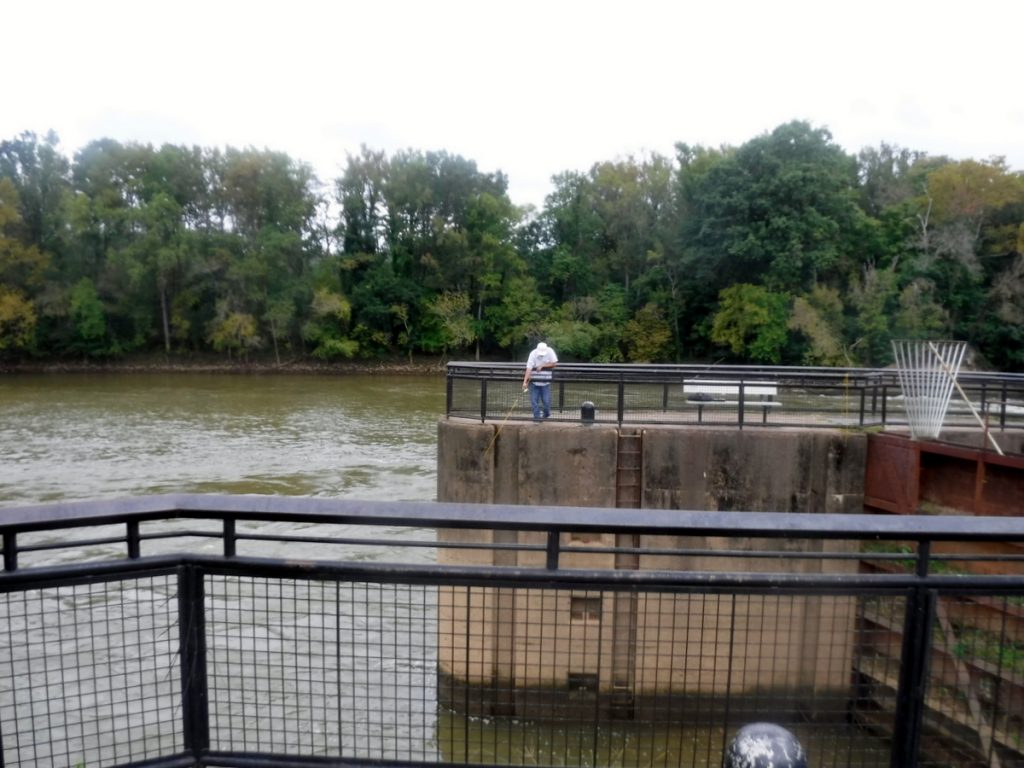
Angler’s target catfish, Alabama, and striped bass, along with crappie from the top of the lock. Photo by JImmy Jacobs.
The lock and dam are part of Floyd County’s Lock and Dam Park today. A short ride from downtown Rome puts you right at the old lock. The 73-acre park boasts an excellent RV and camping park where the sites are level and shady, and many of them offer full electric, water, and sewer hookups.
From its origination in Rome, the Coosa River makes its way some 30 miles into Alabama and feeds Lake Weiss. The lake’s headwaters are actually in Georgia. In years past, Alabama and Georgia stocked striped bass in Lake Weiss annually. As it turned out, the Coosa River’s water conditions and current flow were ideal for striper reproduction.
Striped bass from Lake Weiss migrate up the Coosa River and congregate in a spawning ritual right in and around downtown Rome! Students in the biology department at Berry College in Rome are on the river each spring, taking samples and measurements of the striper population and their spawning activity.

The author with a striper. Photo courtesay of Ron Brooks.
Their efforts have helped biologists determine a measurable amount of spawning activity with the stocked striped bass. The 30-mile transit and current levels provide the necessary ingredients for the spawning to succeed.
Whether the striped bass population in Lake Weiss and the upper Coosa River Basin is autonomous has yet to be proven. But the results are quite positive. This would make the upper Coosa River Basin one of only a handful of self-sustaining fresh-water striped bass populations in the United States.
While stripers can be caught year-round close to Rome, the fish will be on the small side most of the time. But, in April, May, and into June, while the large breeding females are in the area spawning, catches of 30-pound stripers are not uncommon!
All it takes is a small boat that can be launched right there at the Lock and Dam boat ramp. Idle out to the middle of the river, head upstream, and slowly approach the old dam remnants. It is easy to spot. Anchor or use a trolling motor to stay just downstream and within casting distance from the old dam.
Cast a white bucktail jig with a plastic grub trailer up to the rocks and work it back. Not only can you catch stripers there, but a few hefty Alabama bass as well.
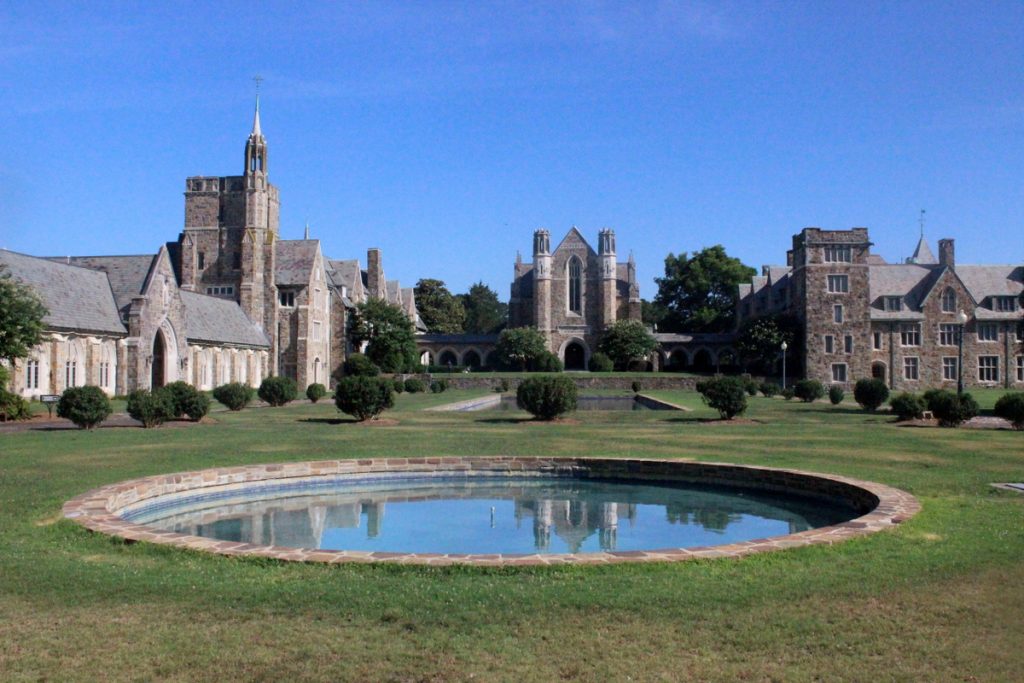
At more than 27,000 acres, a portion of which is in a wildlife management area overseen by the Georgia Wildlife Resources Division, Berry College has the the largest contiguous campus of any school in the world. Photo by Jimmy Jacobs.
Rome is good for fishing, but this fishing is only a small part of the city’s history. Berry College, Shorter University, Georgia Northwestern Technical College, and Georgia Highlands College provide excellent educational and research capabilities to the community. The history of this northwest corner of Georgia is rich.
Ron Brooks was a long-time resident of metro Atlanta and now living in Jacksonville, Florida. He is a member of the Georgia Outdoor Writers Association. Contact him at jbrooks@bellsouth.net.