The guns with which many future hunters took their first shot!
Fall 2026
Article and photos by Tom Seegmueller.
Mention BB guns and the Daisy Red Ryder is generally the first thing that comes to mind. Owning a Daisy was a rite of passage for several generations as so aptly depicted in the 1983 movie, A Christmas Story.
In the movie based in the 1940s a young Ralphie Parker schemes to have Santa Claus bring him the ultimate Christmas gift, asking him for “an official Red Ryder carbine-action 200-shot range model air rifle with a compass in the stock, and this thing which tells time.”
The only problem is that the Daisy Red Ryder never came equipped with a compass or sundial embedded in the wooden stock. Those were distinctive features of the Buck Jones model Daisy manufactured as a pump gun instead of a lever action. Daisy could not convince the producers to use a classic Red Ryder. They eventually agreed to make three prop guns with a compass set in the stock beside a sundial and adding a copper forearm band and front sight.
One of the original prop guns is in the Daisy Museum. The movies popularity led Daisy to produce a Red Ryder with a compass and sundial in the stock for 1983 and 1984. In 2003 and 2008 on the occasion of the 20th and 25th anniversaries of the gun and movie, Daisy produced a limited number of collectible Daisy Red Ryders replicating the originals.
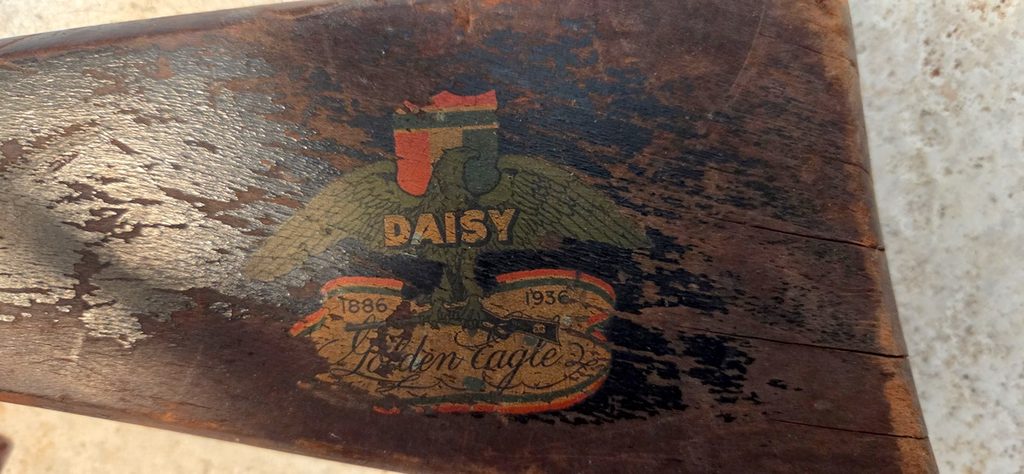
Daisy trace’s the company’s roots back to 1886 when the Markham Air Rifle Company was established in Plymouth, Michigan. In 1888 Clarence Hamilton a watchmaker and inventor approached the board of the Plymouth Iron Windmill Company with an all-metal air gun he had designed. He felt Plymouth had the ability to cast, mold and shape the metal components of his design.
Legend has it that when the firm’s general manager L. C. Hough test fired the diminutive gun in his office he proclaimed, “Boy that’s a Daisy.” Which was a popular positive affirmation of the era referring to something that was appealing or cute. The gun would be named Daisy. By 1895 the sales of the gun were so strong that the company quit making windmills and began the exclusive production of air guns. The first Daisy BB gun was patented in 1889.
The early air guns were designed to shoot lead BB shot, which was readily available as it was already being used in shotgun shells loaded for large waterfowl, including geese and cranes. The standard size of BB shot is 0.18 of an inch. Daisy initially refrained from calling their product BB guns, thinking the phrase diminished their appeal. Around the turn of the century, the company began manufacturing and using a smaller 0.175 lead shot, which traveled at a higher velocity and offered greater accuracy than the original.
As time went by some people believed that BB stood for ball bearing, which lead some economical shooters to use steel balls scavenged from the waste piles of bearing plants. As gun after gun returned to the plant for repairs while continuing to honor their warranty, they found a large cluster of returns located around Minneapolis, Minnesota near the American Ball Company.
Shortly after that the American Ball Company began marketing the Bullseye brand of BBs under a proprietary contract for Daisy. However, Daisy was forced to eventually acquire the company to ensure the consistency and quality of production for a product bearing their name.
A BB is initially shaped from a roll of steel wire which is cut into slugs. These slugs are then compressed from each end forming uniform steel spheres. The spheres are then dumped into grooved flashers or grinding wheels where they are polished until uniformly round and smooth. They are then electroplated with zinc to prevent rust. In the mid-1960s Daisy introduced an orange dye into the zinc to produce their trademark Golden Bullseye BBs.
Over the decades improvements in material and manufacturing processes have led to more uniform BBs providing greater accuracy and velocity. During the Vietnam War, Daisy increased their production capacity to provide shot for Air Force munitions. When that contract ended the demand for steel shot for hunting migratory birds was increasing due to Federal Migratory Bird hunting regulations. At that time Daisy was one of the leading producers of steel shot for the shotgun industry, producing a variety of size shot shots for shotgun shell manufacturers. At the peak of production Daisy was producing 55 million BBs a day.
Today the bulk of all BBs come from China arriving in the United States packed in 55-gallon barrels, weighing 2,000 pounds and containing 2,600,000 BBs. These bulk BBs are sorted for imperfections before being loaded into the iconic yellow and black paper tubes or bulk plastic canisters. The cardboard tube remains the most popular and recognizable BB container on the market.
For over a century Daisy has developed the reputation of being the first gun that many shooters use. The traditional spring piston pump powering BB guns like the model 25 generally have low velocities of about 275 feet per second. These low velocities are a result of the weak springs used to make cocking these iconic rifles easy for young shooters, which is a key consideration for the company. A recent survey showed that 88 percent of shooters took their first shot with a Daisy.
The Model 1938 Red Ryder is still a popular model, and Daisy has developed a shooting system around it focusing on all aspects of shooting safety and responsibility. The current catalog also contains Match Grade rifles for competitive shooting at the highest levels. Not only do they provide the guns, they also offer a Daisy shooting education program, allowing shooters to compete in the Daisy Nationals BB and air gun championship match that offers college scholarship opportunities.
Tom Seegmueller writes for the Albany Herald newspaper in his hometown. He is a member of the Georgia Outdoor Writers Association. Tom can be contacted at tmseegmueller@gmail.com.