Fall 2026
By Capt. Cefus McRae
Lots of folks put their boats away for the winter. Some cover them with a tarp or factory boat cover, and some folks store them in the garage or covered storage unit. Now your boat will sit out the winter doldrums and dream about its next trip to the water. During these cold months, a number of crazy things can develop that might delay your re-launch next spring. Fortunately, there are simple solutions to prevent these wintertime gremlins from appearing. And most of these measures take only a few minutes.
Let’s imagine you took your boat out late this fall. You put it on the trailer, pulled the drain plug, and parked it in the yard or in the garage. Good to go…right? Well, maybe not.
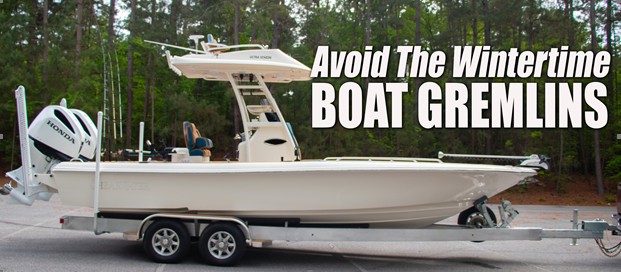
Depending on exactly where the boat is stored, the environment they’re living in can be cozy or harsh. Outside storage can expose your boat, motor and trailer to sub-zero temperatures, wind, rain, and all kinds of critters from chipmunks to insects to birds. Falling leaves, limbs, and dust also factor into the equation. Boats stored with a cover face other foes…moisture and humidity. They can be the source of a lot of problems; from corrosion on your electrical connections to damaging your fabrics and upholstery. If the cover isn’t properly placed to allow rain water to drain off, you can wind up with huge pools of water that ultimately add weight to the trailer and can damage your tires or suspension. Something to think about.
Now that I’ve got your attention, here’s a few things you can do to keep those wintertime gremlins away.
1. Remove your PFD’s (lifejackets and throwables) and put them in a dry place. Lifejackets are probably the single-most overlooked, and important, item on boats these days. It’s the old ‘out-of-sight, out-of-mind’ thing. Check them for mildew, and clean them really well. Really tug on the straps and the seams where the neck meets the front flotation pieces. If there’s a tear or signs of weakness, replace them. If you get stopped by the DNR, Coast Guard or Marine Patrol, and they see tattered PFD’s….guess what…those no longer qualify as reliable devices on the boat, and you could wind up with a ticket. And if you ever find yourself in an emergency where you need them, no one wants a lifejacket that’s falling apart as they put it on.
2. Check your fire extinguisher. Nowadays, fire extinguishers have expiration dates in addition to the ‘charged’ gauge or indicator. Even if it seems OK, the dry chemical extinguishing agent in your fire extinguisher has a tendency to settle in the bottom of the canister. And since boats ‘pound’ as they’re zipping across the waves, the powder can cake up in the bottom. That presents the possibility, if you ever needed to pull the trigger, all that comes out is propellant…not the fire extinguishing powder. To keep the powder fluffy inside, flip the extinguisher upside down and slap it on the bottom a few times with the palm of your hand or a rubber mallet to get all the powder stirred up again. Also, small wasps have a habit of building their mud nest inside the nozzle, so use a flashlight to really check the outlet to make sure it’s clean and free of debris.
3. These may seem really obvious, but here goes. Check your oil and lower unit fluid. Spray some engine fogging oil as recommended by the manufacturer. A full gas tank is better than a half-full gas tank. Less opportunity for condensation to build up in the tank. Ethanol gas is nasty for marine engines, so add some fuel stabilizer to the tank then take the boat out (on the trailer) for a neighborhood spin to mix it up well.
4. OK, here’s one more for good measure. Remember Point #2? Well, those pesky dirt dobbers love to build a mud nest in the Tell-Tale outlet of outboard engines…the small hole on the side of the motor that spits out water to let you know the water pump is working. I know, that’s a really tiny hole, but those little wasps are particularly partial to those openings. And they’ll also build their nests in the fuel vent on the side of the hull too. If you crank the engine and no water is exiting the Tell-Tale, cut a short piece of lawn trimmer cord and gently push it up into the hole. If muddy water starts coming out, you’ve found the problem. Continue gently rotating the trimmer line until the water runs clear. If you don’t get any water, then you may need to investigate further to see if you have water pump issues.
Capt. Cefus McRae of Hartwell is the star of the television series Nuts & Bolts of Fishing on CarbonTV and a number of other cable and internet outlets. Cefus also is a member of the Georgia Outdoor Writers Association. He can be contacted at cefus@nutandboltsoffishing.com.