Backyard wildlife can be amazing!
Fall 2026
Article and photo by John Trussell
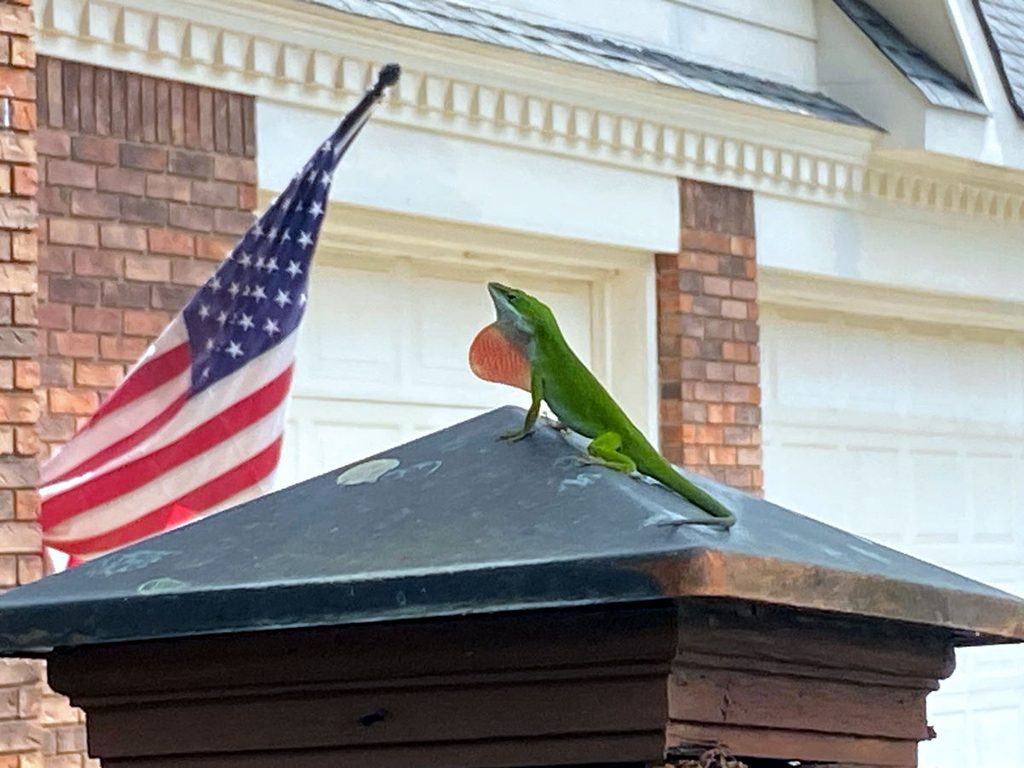
On a warm summer morning in Houston County, the backyard can seem quiet—until something small and green suddenly darts across a fence. There, watching from a sunny leaf, is one of Georgia’s most familiar reptiles: the green anole, scientifically known as Anolis carolinensis. Although it is only about 5 to 8 inches long, this little lizard has a dinosaur-like profile.
But Extinct dinosaurs have no modern lizard descendants. Instead, living birds are surviving dinosaurs, making a sparrow or a chicken far more closely related to a T. rex than an iguana is.
Imagine a green anole named Jasper living in your backyard. I named this lizard Jasper to honor William Jasper, an American hero that died in the battle of Savannah in 1779. Jasper spends much of his day climbing shrubs, vines, fences, and trees in search of food. His favorite meals are insects, spiders, and other tiny invertebrates. He may sit perfectly still for several minutes, watching a fly or cricket. Then, in an instant, he launches himself forward and grabs his dinner. You just had a National Geographic television moment in your backyard!
But Jasper has another talent that makes him look almost magical: he can change color! People sometimes call green anoles “chameleons,” but they are not true chameleons. Their color changes are connected to things such as temperature, activity, and stress. On a warm, sunny day, Jasper may appear bright green. When he becomes cool, frightened, or inactive, he may turn brown.
One afternoon, Jasper notices another male anole entering his territory. He knows exactly what to do. He raises his head, begins bobbing up and down, and suddenly unfolds a bright pinkish-red flap of skin beneath his throat called a dewlap. It looks like a tiny flag waving in the sunlight. Male anoles use this colorful display to communicate with rivals and attract females. The newcomer backs away. Jasper has won the challenge.
Later, danger arrives from above. A bird spots him. Jasper freezes against the bark, hoping his camouflage will save him. If the bird grabs his tail, however, Jasper has one more astonishing defense: his tail can break away while he escapes. The tail can eventually grow back, although it may not look exactly like the original. Maybe one day our scientists can figure out how to help humans grow back a finger or other damaged body parts from lizard cells?
As evening approaches, Jasper disappears beneath a piece of bark. Soon the backyard becomes quiet again.
Green anoles are common across much of Georgia and are often found close to people in gardens, neighborhoods, trees, fences, and even rooftops. I see lizards just about every time I walk out the back door. They may be easy to overlook, and are often ignored, but these small reptiles play an important role in the backyard ecosystem by feeding on insects and becoming food for larger animals.
Last year, my wife Billie and I found a red tail hawk trapped under a medal fence in our back yard. I suspected that it got trapped chasing a lizard. We were able to free the hawk and fortunately it had no injuries. That same hawk built a nest in our yard and hatched out two chicks.
So, the next time you see a little green lizard racing across a Georgia fence, stop for a moment. You may be looking at a tiny hunter, climber, escape artist, and color-changing performer – all living right outside your door.
John Trussell is a freelance writer making his home in Warner Robins. He is a member of the Georgia Outdoor Writers Association and a 2014 inductee into the Georgia Hunting and Fishing Hall of Fame.