Clams, Conservation, and Charlie
Summer 2026
By DaWayne Spires
I was sitting on my back deck when an e-mail from Gunner Hall about the upcoming Georgia Outdoor Writers Association Spring Conference in Darien flashed up on my phone. He had listed some of the activities that would be offered to our members. Each year, our first vice-president sets up our conference at a city, town or locale with activities with story lines to promote our host.
As I read the e-mail, one listing hit me like a runaway turnip truck. It read as “airboat ride to active clam farm with limited seating.” I immediately called Gunner and reserved the “limited seating” before anyone else had a chance. The limited seating turned out to be for just one person.
An airboat ride was on my bucket list, and I have a deep and abiding love of food that has either scales or shells. To say the least, I was stoked. I started researching clam and oyster farming so I would to be able to ask intelligent questions of guide Charlie Phillips, the owner of Sapelo Sea Farms. My adventure turned out to be far more than a boat ride and seeing seedling clams in bags placed and spaced out like soldiers at parade rest in coastal mud flats is an understatement.
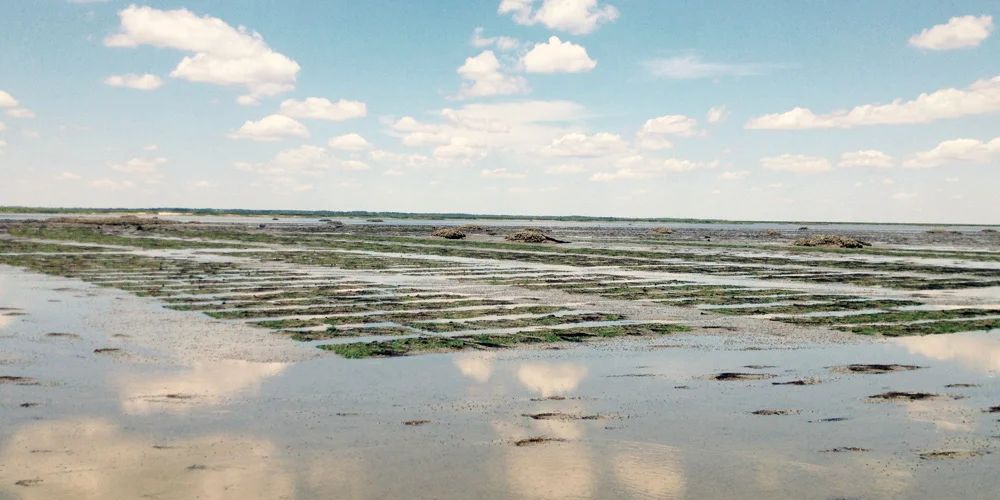
Clam beds in the Georgia marsh Photo courtesy of Sapelo Sea Farms.
I talked to Charlie on the phone a few days before our event. He seemed like a really nice fellow. We set up our meeting place and time. I tried to be the professional outdoor writer as we spoke for about 30 minutes as he answered a number of my layman questions all the while, I was wondering if clams are best fried, steamed or raw.
I was to be at Charlie’s place of business at 7 a.m. on Friday. Due to Georgia’s tidal schedule, we had to leave with the morning low tide. I arrived first. As I waited for my host and guide, my South Georgia mind began to wander about what to expect. Charlie soon arrived and where I was expecting perhaps someone, who owns and operates a highly successful seafood restaurant and shellfish distribution business, who is on several federal councils on maritime conservation, and who might have secret agendas that were hidden by a polite smile; I saw a man get out of his truck wearing work boots, an untucked flannel shirt, hair pulled back into a ponytail under a Sapelo Sea Farm hat. Charlie Phillips was 70 years old with bearing of a man who has seen more than the average person has and has worked hard living it. He had a soft-spoken intelligence that drew you in and made you want to hear what he had to say. I liked him and knew that for the next few hours, class was in.
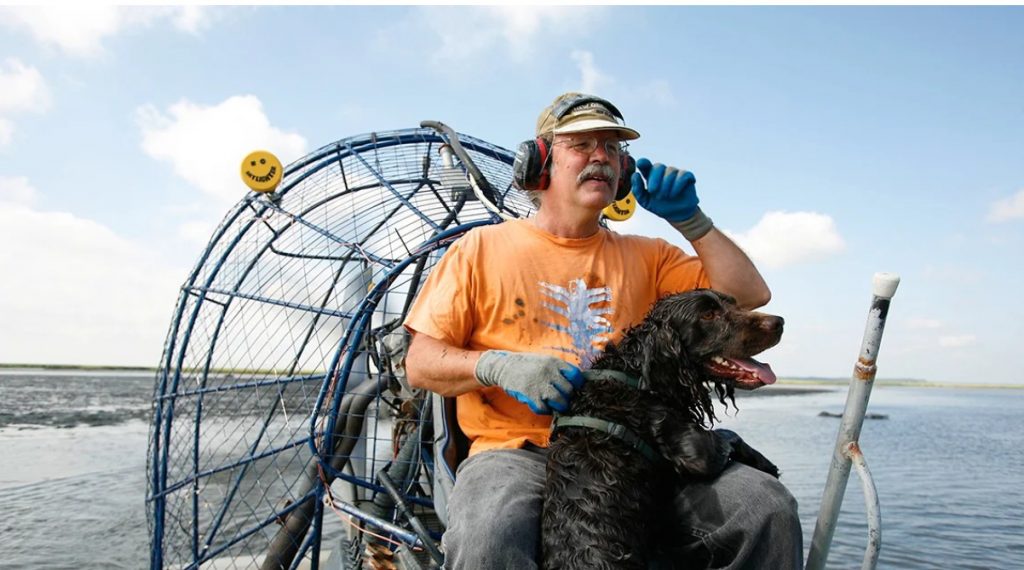
Charlie Phillips and his airboat. Photo courtesy of Sapelo Sea Farms.
We exchanged pleasantries and proceeded down to where his air boat was docked. His means of inter-coastal transportation was not the air boat that I have seen on countless outdoor documentaries or on as many action-packed TV shows and movies. It was huge, perhaps 20 feet long, with an engine that I am sure with the proper wings could have flown us to Cumberland Island and back. The ride out to where his employees were working a bed of clams was exhilarating. It was there that he killed the engine and we talked. This was to be the theme of our trip. We would ride a bit, then stop and talk. Charlie’s knowledge of coastal conservation and Georgia’s salt marsh history was amazing.
Charlie Phillips was born in Jesup in 1955. His father was a shrimper. Charlie learned that trade at a young age on the deck of his father’s shrimp boat, a trade he applied through most of his adult life. In the meantime, his father began selling shrimp off a pier in Darien, which in time became Phillips Seafood. In 1996, Roger DeWitt approached Charlie’s father about a business venture. Roger owned a stretch of mudflats called 4 mile Island that had a King’s Grant deed. A King’s Grant is a colonial-era deed where the English Crown transferred land ownership to early settlers in the American colonies. All lands at that time belonged to the king. These documents serve as a foundational root of title for many coastal marsh and riverbed properties today.
The 1000 acres of 4 Mile Island mudflats became the first operating clam farm on the Georgia coast with the help of the University of Georgia Marine Extention supplying the seed clams. In 1990, Charlie began running his father’s clam operations, after years shrimping from Corpus Christi to Key West. He claimed he needed “a place on the hill.” It was his way of saying that he needed some roots.
It takes 2 1/2 years from original seeding to the maturity of the clam. They pull and sort the clams several times in this growing period according to size and health. The dead clams are discarded, the smaller ones are returned to the bag and relocated to beds of clams of similar size, the larger clams that are size specific to particular age are bagged and returned to designated beds for that age and size group. A 20-percent loss is expected with each sorting. This is essential for high quality farmed clams. In 2000, Charlie bought the business from his father.
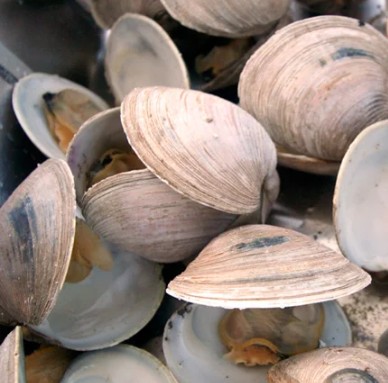
Photo courtesy of Sapelo Sea Farms.
Technically, that is the basics of clam farming stripped down to layman’s terms. The science of maritime aquaculture is far above my poor South Georgia reasoning. I am just glad there are folks like Charlie who understand the science, the business and the conservation aspects that make Sapelo Sea Farms a viable enterprise that is both profitable and environmentally sound.
As we toured the salt marsh visiting assorted clams, Charlie took a detour and we wound up at a spot where the bank of the marsh was higher and the water had cut away part of it. Exposed about 3 feet down was part of a dead tree. Charlie pointed at the tree. He said he brought a marine biologist to this very tree. He told me he took a sample and had it carbon dated. It came back as being over 2900 years old. Before me was a dead tree that had been alive 900 years before the birth of Christ. It was still acting as a part of the ecosystem. As Charlie explained the ramifications of just this one tree, I envisioned Mother Nature and the Georgia coastline in an intricate dance that has spanned eons.
Charlie Phillips is on the South Atlantic Fishery Management Council. It is one of eight regional fishery councils in the United States that were established in 1976 through the Magnus-Stevens Fishery Conservation and Management Act to manage fisheries in U.S. federal waters. It is responsible for federal waters ranging from 3 to 200 miles off the coasts North Carolina. South Carolina, Georgia, and east Florida to Key West. He is also member of the Atlantic Large Whale Take Reduction Team. In 1997, this plan was developed to reduce the level of serious injury and mortality of three strategic stocks of large whales (North Atlantic, Humpback, and Fin) in commercial gill nets and trap/pot fisheries. His influence on the conservation of maritime resources is substantial. All this from a simple man wearing a flannel shirt and old work boots, who causally shipped 50,000 clams to a New York seafood distributor as we spoke.
My eyes were genuinely opened in the time I spent with Charlie. My mind was expanded and I had life boxes checked. I ate fresh raw clams (succulent and briny). I did not get to eat at his restaurant, The Fish Dock at Pelican Point. I checked the reviews. They were all 5 Stars.
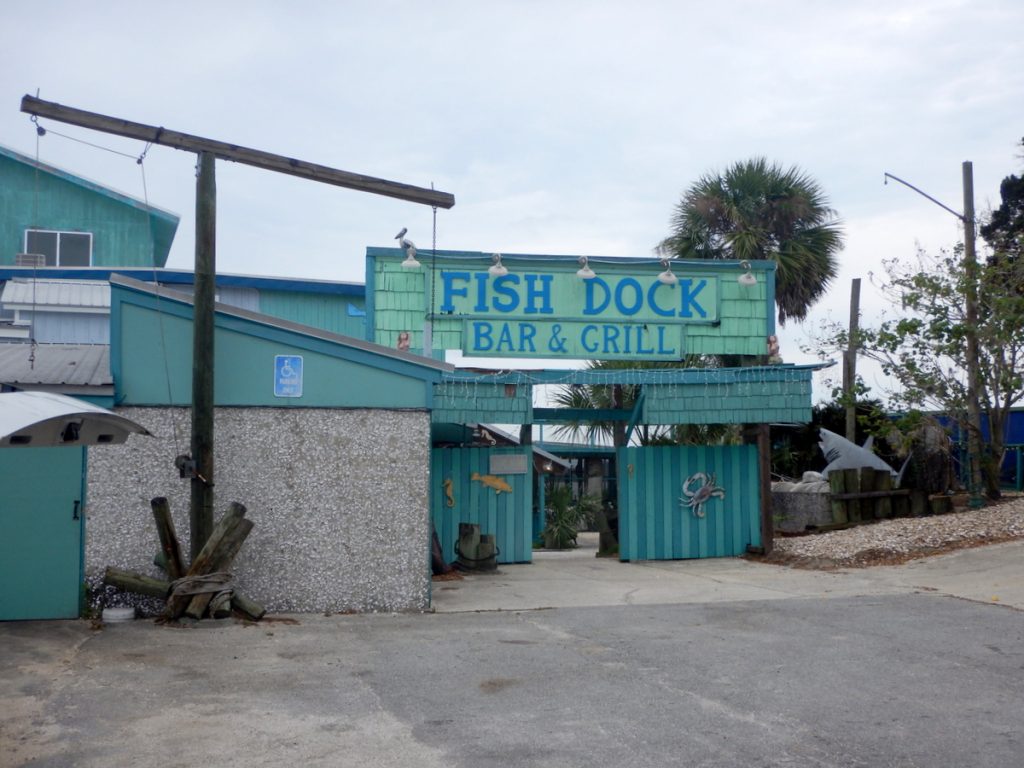
Photo by Jimmy Jacobs.
Expectations are a funny thing. Some fail miserably, others pass adequately, and then there is one that exceeds dramatically. Sapelo Sea Farms was a definite bucket list trip with extra bits of extraordinary thrown in that caused my experience to exceed the whole of its parts. Charlie wanted me to leave you, the reader, with this thought,
Take care of the environment
And the environment will take care of you.
To me, that is just clams, conservation and Charlie in a nutshell or is that a clam shell. It does not matter as long as the bivalvia fits.
DaWayne Spires is a freelance writer who makes his home in Toccoa. He is a member of the Georgia Outdoor Writers Association. He can be contacted at redneckironchef@gmail.com.