Post thinning habitat improvement through new and improved food plots
Summer 2026
By Brandon Adams
Just as a gamekeeper manages the deer, turkey, quail, waterfowl, on one’s property a gamekeeper must manage the timber. Some hunters do not understand the importance of timber stand management. Acorns only last so long, and wildlife need a source of food year round. Without a year round food source wildlife will leave your land in search of food. Timber thinning is one tool in the gamekeeper’s tool box. Create year round food sources by expanding existing food plots, and creating new opportunities for food plots in areas that otherwise would provide little food for wildlife due to the lack of sunlight hitting the forest floor. Timber thinning also provides you with income to purchase new equipment and implements to make expanding, and creating new food plots possible. It also allows you to take prior knowledge of game movement on the property into consideration in the process of updating and creating new food plots. Change can be a good thing if the gamekeeper is prepared to take advantage of the opportunity that is presented.
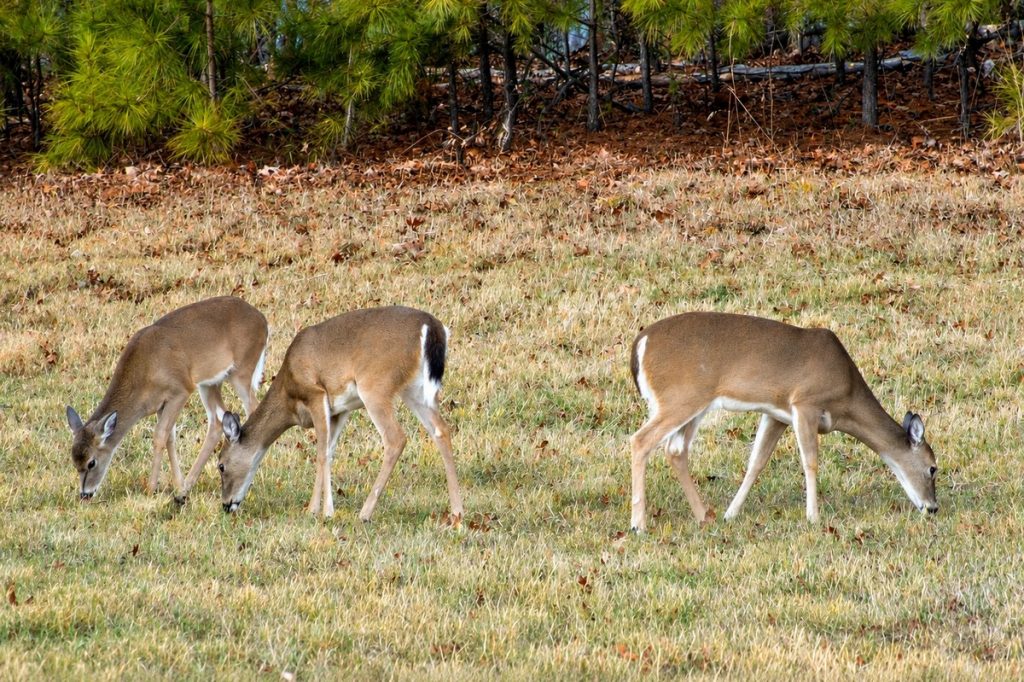
The habitat needs to be able to feed the herd. Photo by Jimmy Jacobs.
The process does not start after the timber has been cut, and after the timber crew has left the property. The process starts before the first piece of equipment rolls off the trailer. The first step we took prior to having the timber thinned on our land was to start to look at land that was being cut or thinned in the area near our property making note of locations in which the land was left in the condition that we felt matched our expectations. We also talked with other landowners to learn about the experiences that they had, learning from their successes and failures. After a couple of years, my Dad, Bill Adams, made contact with a couple of the timber companies that we had felt would be able to meet our needs and expectations. The owners met with my dad on the property, and told him based on the value of timber at the time it would be best to wait a few more years to maximize profit potential. After a few years, we felt one company would best meet our needs. The owner of the company returned to the property to survey the timber. He wanted to give it one more year, and a contract was signed. We made sure that our goals were outlined in the contract with the timber company including thinning the pines, removing less desirable hardwoods such as sweetgums, expanding existing food plots, and working with us in selecting where loading docks would be placed.
In order for the food plots to reach their maximum potential, we needed to remove competition from trees that we had left in the food plots when they were created when we first purchased the property that was partially clear cut. The pines that we had left had grown tall, and had started to shade out the food plots. They also removed valuable moisture from the often drought starved food plots. In the process, we wanted to also expand the food plots to provide more food for the deer and turkey on our property and draw in deer and turkey from surrounding property that lacked food plots of any size.
We also wanted to create new food plots in certain selected areas to use as staging areas for deer prior to entering the larger food plots, or as attractant food plots where food was limited prior to thinning. This was accomplished by requesting loading docks to be located in selected areas, and marking areas for all the timber to be removed to create openings to establish new food plots. We also requested that logging roads if possible be created in consideration of prevailing winds and existing travel corridors.
As the time drew near, the owner of the timber company contacted my Dad, and arranged a time for him to meet with the owner’s son. When they met, they marked out the new boundaries we wanted to establish with the expanded food plots. They also marked areas in which we wanted to create openings for new food plots. The locations for loading docks were discussed, and all of the areas that we had hoped to have them they were able to accommodate. The goals of the thinning were also discussed, and the next day the timber crew was scheduled to arrive.
The next day, the crew arrived, and the process of managing the timber habitat on our land had begun. Loading docks were established. Food plots were expanded. New food plots were created, and sunlight was once again reaching the forest floor. The change had begun, but this was only the first step.
The timber crews finished up, and left. A check was sent in the mail. At first glance, I had mixed emotions like most gamekeepers. I had remorse for what was gone, but excitement for the potential that had been unlocked. It was now time to clean up the existing food plots, work on establishing the new food plots, and getting the loading docks ready to plant.
With the money from cutting the timber we were able to purchase new implements for the skid steer and tractor to help with getting the older food plots and new food plots into shape. We bought a grapple for the skid steer to pick up the limbs and tops that were left behind. A subsoiler was also purchased to help break up the ground that had been compacted by the equipment. Both of these were not that expensive to purchase, and made the job so much easier. We also invested in a larger bush hog and sprayer to help control the sweetgums that sprouted like weeds.
We started by cleaning up the existing food plots first due to the fact that they were the most ready to plant to be able to get some seed in the ground the first year if we were not able to get the others ready in time. We had limited time that we were able to be on the land working with my Dad, being the owner of a cabinet shop, and myself, being a school teacher. We utilized the limbs and tree tops left near the food plots to create funnels to force deer to enter and leave the food plots in areas that were advantages to us. This was also used to give the deer a sense of security, and encourage more daylight use by creating screening for them. Prior to creating these screens it was seldom that we saw any deer in our food plots, but now most evenings deer are seen in the food plots. Night time use has also increased as well based on images collected from trail cameras.
Our next step was to work on cleaning up the loading docks and clearings in the areas that we wanted to create new and staging food plots. This process took much more time due to the amount of material that needed to be moved and burned. We also needed to remove stumps to allow for easier plowing. We repeated the same process, but on a larger scale with creating screens and funnels. Next, we needed to clear rocks from the food plot. Our land lies partially along a ridge that has a variety of sized granite boulders. The areas we selected did not have any of the larger boulders, but had an abundance of small boulder and rocks from basketball size and smaller. These rocks were put to use by filling in low areas in the road system on our land that were created by the logging equipment.
Our final step in the clearing process, was to clean up the logging roads to create linear food plots and shooting lanes. This step was saved for last because we felt it would add little nutrition to the wildlife as compare to the other projects. This was a step mainly to improve hunting opportunities by creating travel corridors, and smaller food plots that deer could utilize as they moved from bedding areas to large food sources and return to their bedding areas. Prior to having our timber thinned, the longest shot that was possible on our land, not counting the food plots, was approximately 30-50 yards. Now by having the logging roads in place, and cleared, we have a shooting lane that is 100 yards with several trail crossings.
We also worked to shape the surrounding land to create bedding areas. The natural process of thinning created large amounts of native browse as well for the deer to eat. We sprayed and bush hogged sweet gums and other less desirable trees to maintain the openness and to maintain the native browse as well.
The logging and clearing had now been completed. We still had more work to do prior to planting. The first step we took once the areas had been cleared, and the most important, was to take soil samples from the new and old existing food plots. We made sure to collect samples from a variety of areas in the food plots to insure an accurate reading of the lime and fertilizer that needed to be added to insure that the seed we planted would reach its full potential. Some of the results that we got back actually pleasantly surprised us in the existing food plots, but the new food plots showed the results of the history of the poor soil management that is found in most areas of the rolling hills located in the piedmont regions of the Southeast and other areas throughout the United States. Lime was added to reach the needed soil pH along with fertilizer based on the soil sample results. At the same time, we subsoiled and tilled the ground to get the hardpan created by the logging broken up.

Click the photo for more about Mossy Oak Biologic products.
Through research, and talking with other hunters, we decided to plant Mossy Oak BioLogic Clover Plus and Mossy Oak BioLogic Winter Bulbs and Sugar Beets. We also used wheat as a cover crop for the deer to feed on allowing the BioLogic the opportunity to germinate and have a chance to mature. The food plots were plowed again, and the cultipacker was ran over the plowed soil to create a good seed bed. Seed was then spread. The wheat was spread using the tractor, and the Mossy Oak BioLogic seed was spread using a hand spreader. We then followed with the cultipacker again insuring good soil contact. The seed has done well in our red clay soil, and our food plots have been utilized more this year with this prep work, and seed choice than ever before. By the time the deer season came to an end, the food plots looked almost as manicured as the finest golf courses. The food plots have become a year round food source for the wildlife in the surrounding area that is lacking in food plots. With the warming temperatures of spring, and less pressure from deer, the food plots responded creating nutrition for lactating does, fawns, and turkeys.
Timber management, if done correctly with proper research and planning, can be a great tool in the gamekeeper’s tool box to make their land more attractive to wildlife. Timber thinning can allow daylight to reach the forest floor for the first time in several years. This creates an increase in the native browse that is available for wildlife. It also allows for the remaining timber to receive more moisture and nutrients to grow and flourish producing more acorns and fruit. Timber management allows the gamekeeper to expand and create new food plots, along with travel corridors, and shooting lanes. It also allows the land to be able to hold more wildlife, and even draw wildlife from surrounding lands. By creating more food sources, the health of the wildlife will also improve, deer weights will increase, and healthier does also results in healthier fawns. Thick areas of new growth will provide more bedding habitat for deer along with protection for fawns, poults, and rabbits. Sightings of wildlife will also increase. This is always a positive especially if the property will be used to introduce new hunters to hunting, or have youth hunts. Some people fear change, but the gamekeeper knows that change unlocks potential. That change is indeed a good thing.
Brandon Adams is an award-winning outdoor writer and member of the Georgia Outdoor Writers Association. Brandon makes his home in Comer. He can be contacted at Badams4160@windstream.net.