Options on public land
Spring 2026
By Polly Dean
(Editor note: Unfortunately, the vast majority of upland bird hunting in the Peach State now takes place on plantations or hunting preserves, which can be expensive as a regular habit. Here the author offers her experience with dogs and another do-it-yourself option.)
An eager bird dog or two (mine double as couch potatoes and pets), pen-raised quail, and wildlife management areas providing designated areas for training dogs are all that are needed for pursuing an enjoyable pastime that you can share with family, friends and your favorite canine companions. Releasing and hunting quail behind a good dog is a pleasure, and great exercise for all involved, especially the dogs!
As for the bird dog, my friend Jimmy owned some English Setters and a couple of Brittanys. He was given the dogs from breeder friends that were culling their packs for whatever reasons. A few years later I had the chance to “adopt” a free dog as well, and jumped on the opportunity. Chloe was a 3-year-old English setter that the breeder had determined she wasn’t going to breed. I was curious to ask why, but decided against it. It turned out it didn’t matter. Chloe was polite, trained to hunt birds and a great all-around pet and companion. She just recently turned 15 years old, which is quite old for an English setter. I ended up falling in love with the breed, and also purchased as setter pup from the same breeder. Carly is now 3 1/2 years old and is as incredible a pet and bird dog as her mentor Chloe.
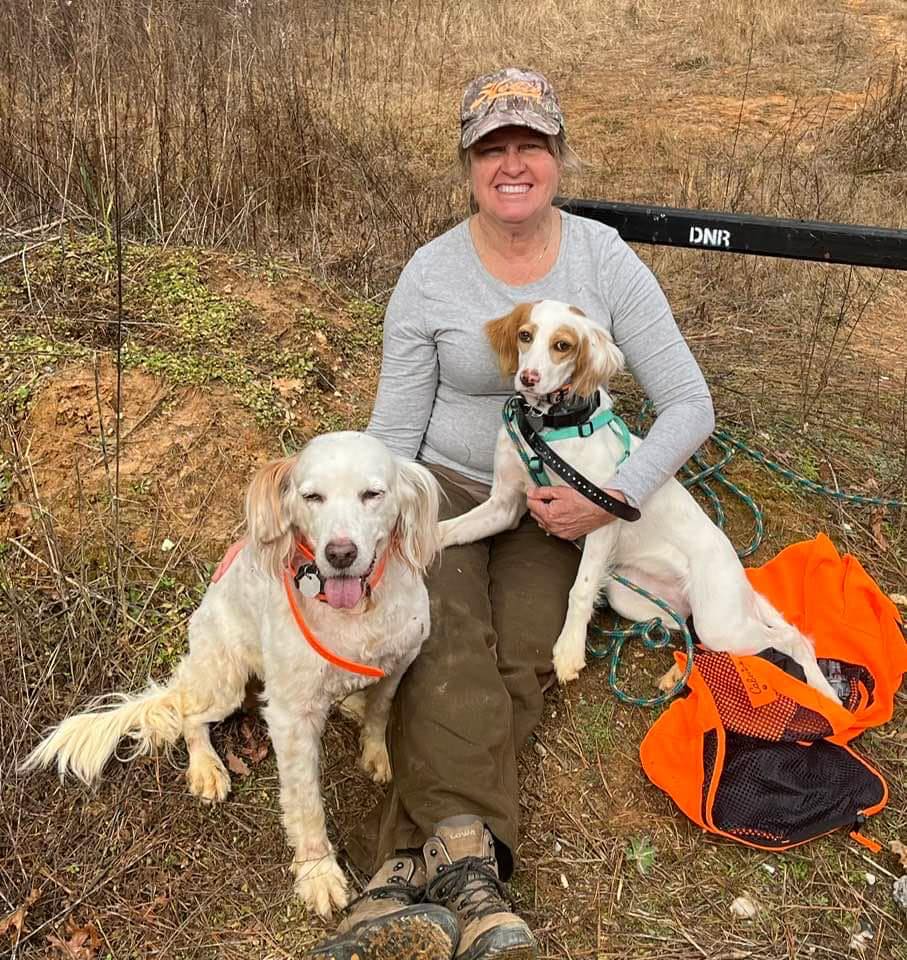
The author with Chloe and Carly. Photo by Jimmy Jacobs.
After hunting behind Chloe and Jimmy’s dogs for a number of years, I had learned a few things from our experiences in the field. I do not claim to be an expert on the subject, but am happy to share what I’ve found over the years works.
Carly was born in the summer and only a few months old when she was to experience her first hunting season. I did learn with Chloe, English setters have a lot of energy and like to run, fast! Because, I wanted to see Carly again after releasing her on a property that encompassed acres and acres, I figured that I had better have her under control and respond to my commands when I called her. I used the term “here!” and that was basically all I concentrated on for training her to eventually join us the field.
“Whoa” is another command Carly hears when I don’t want her to move in too fast or close to a located bird. The dogs seem to naturally learn to “honor” other dogs when they’ve located and are on point. It is the most fun just to watch the dogs do their thing! When working with Carly, I often didn’t even carry a gun, when I knew the other guys would do the shooting. I just enjoyed watching and working with her.
With Carly being so young during her first bird season, I mainly wanted her to enjoy the experience and have fun! I figured her breeding, would soon enough bring out her bird-hunting instincts. Having her follow behind and join the other experienced dogs would be the best training. Carly had a blast running with the other dogs and with each hunt she learned more and more about why she was out there. Most importantly, she loved it!
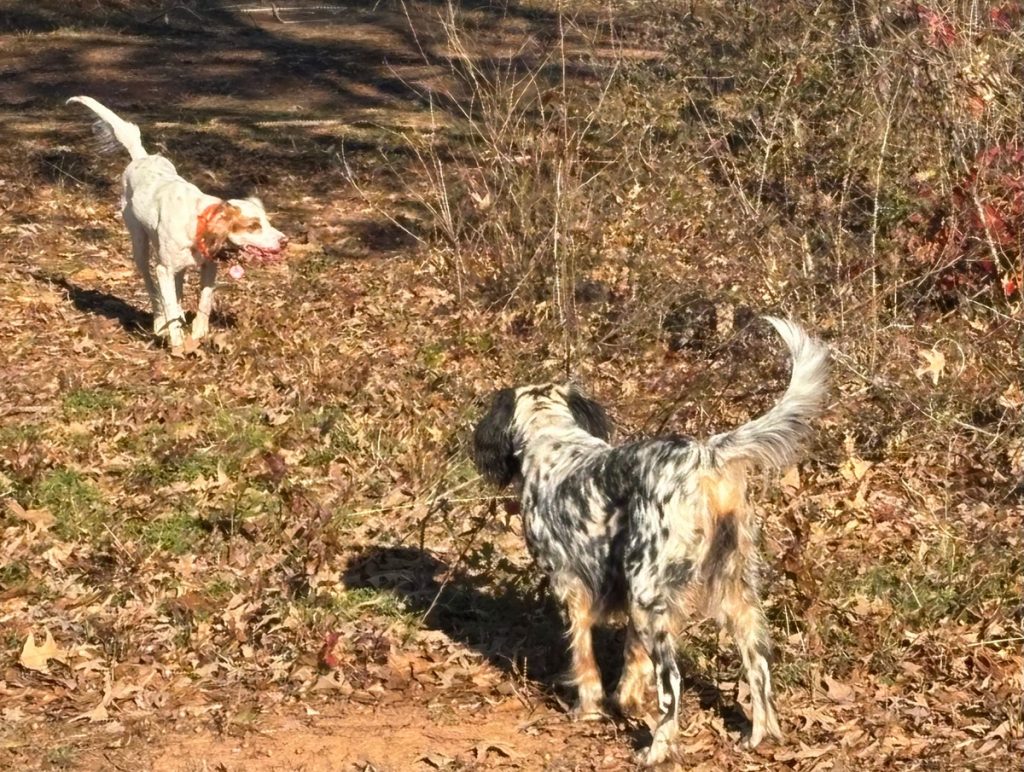
Carly “learning” from an older dog. Photo by Polly Dean.
Using “positive reinforcement” rather than punishment, is my rule of thumb. I have hunted behind a dog that didn’t at first enjoy the experience and found his way to our car rather than hunt. He very likely had an unpleasant experience with his former owner. No trait in the dog, to me, is much more important than having an enthusiastic partner when in the field. Not to mention, the pure enjoyment it adds to the sport!
I use a shock collar on the dogs, and mainly “tone” them, which produces a beep from the collar rather than actually “shocking,” to discourage behavior that will get them into trouble, such as going into roads or roaming beyond property boundaries. I rarely use the shock setting on them and again, I am a strong believer in positive reinforcement rather than negative. In fact, Carly gets so excited when she sees the shock collar out and is eager for me to put it on her, because it means she gets to go hunting.
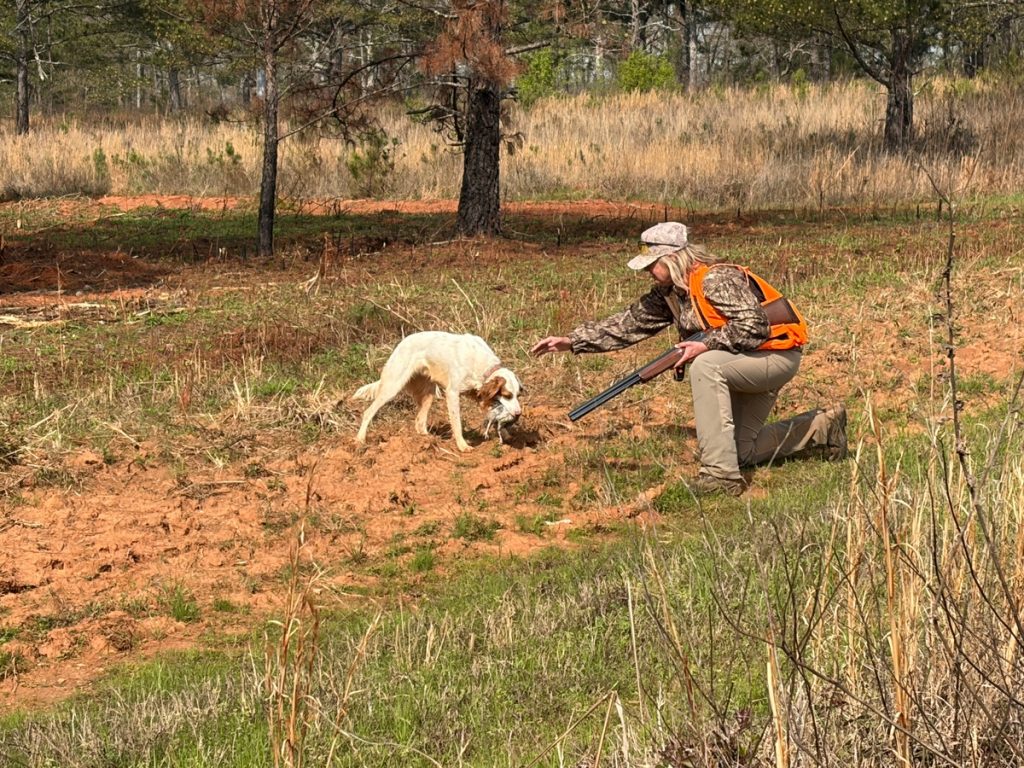
Carly with the retrieve. Photo by Lou Arcangeli.
We also try to avoid hunting in warmer temperatures. Though often, this can be a challenge in our state, we prefer to choose days with temperatures starting out cool in the mornings and not reaching much above the upper 60-degree range in the afternoon. We make it a short hunt if it gets too warm. We do this for the good of the dogs. They are always happily working hard and just don’t know how to slow down or pace themselves. We don’t want them to overheat themselves. We carry plenty of water for them in our vest and offer to them often.
There are businesses that raise and sell pen-raised quail throughout the state. I happen to use South Fork Plantation, a hunting preserve in Royston. Each spring I reserve a number of quail for the coming season. They require, as most places do, a small deposit for the number of birds we want to reserve for the season. We usually pick up the birds the day before our hunt. A couple “cat crates” are ideal for this purpose. Our rule of thumb is to release at least 6 birds per hunter. Also, Georgia regulations required you to have a receipt on hand for the purchased quail released during your hunt on public land.
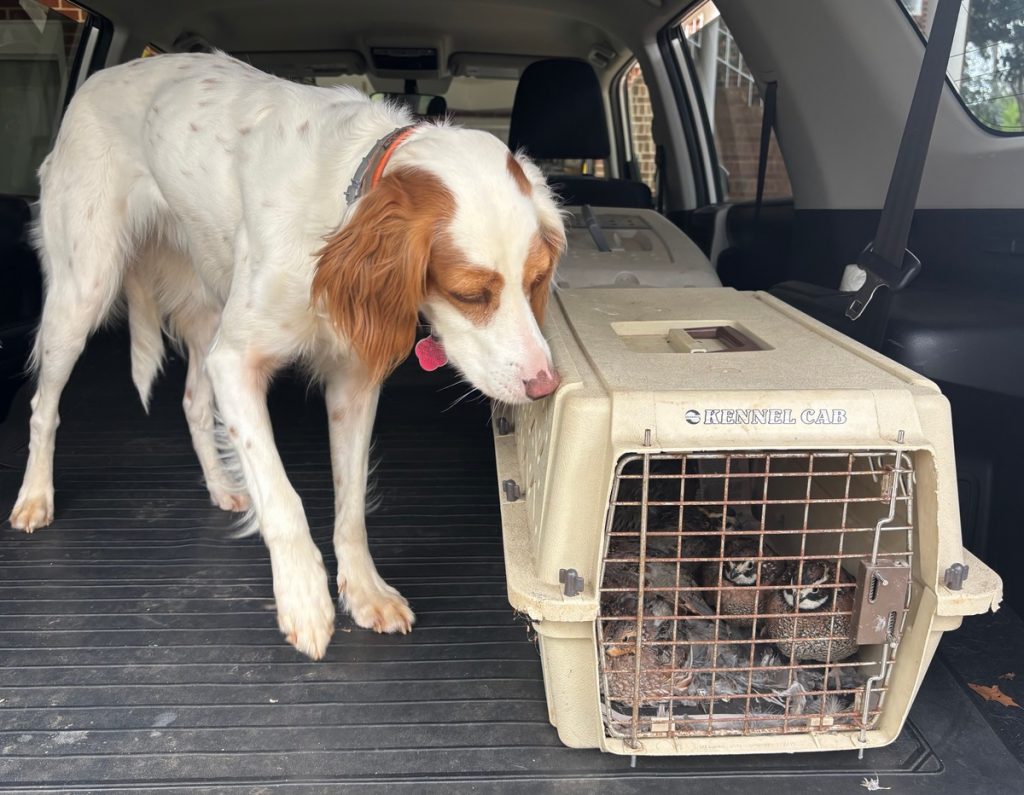
Photo by Polly Dean.
We do our hunts on Dog Training Areas, located on a number of the state’s wildlife management areas. Releasing birds is not allowed on public land, except in these designated areas. We arrive at the training area about an hour before we plan to hunt, leave the dogs in the car and put out the quail. We release two to four birds at a time, in various locations. Additionally, we simply let them fly where they please. As a result, it makes for a more natural hunting situation. We return to our vehicles, get the dogs and start the hunt for the birds.
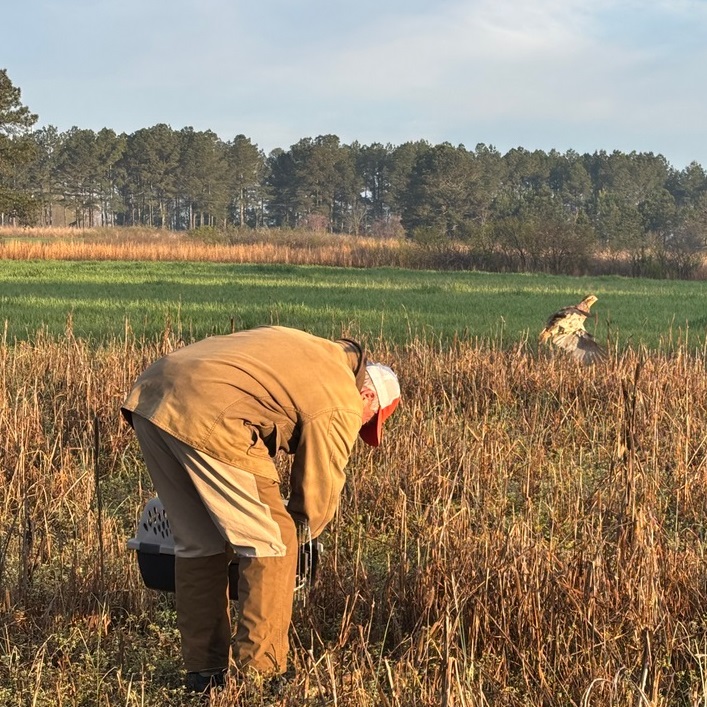
Releasing the quail. Photo by Polly Dean.
There about two dozen bird dog training areas throughout Georgia. It is advisable to check out their individual websites for dates and regulations that may vary between the properties. You can find that list of properties by clicking here.
South Fork Plantation in Royston offers onsite quail hunts and pheasant shoots. For more information, click here.
Polly Dean is an award-winning writer, photographer, angler and hunter, who makes her home in Athens. She is a member and past president of the Georgia Outdoor Writers Association. Polly is the Associate Editor of On The Fly South. She can be contacted at pollydean22@gmail.com.